My Argument Against Benatar

As I mentioned a couple of posts ago, I went to a philosophy conference on the ethics of procreation a couple of weeks ago. I presented an argument against Benatar’s antinatalism. I will expand this into a submission for a book chapter, but I hope to give one aspect of my conference paper in brief today. In short, Benatar main argument for antinatalism, the view that it is morally wrong to have children, rests on the idea that there is an asymmetry in our intuitions between the absence of pain and the absence of pleasure of those who are yet to exist, and that this asymmetry suggests that it is both morally better and in the interests of all potential persons to refrain from procreation.
Here, I will show that we should not believe any such asymmetry intuitions! And thus, Benatar’s case is undercut! This is, as far as I am aware, a novel critique of Benatar. The other counterarguments of which I am aware will often give distinct arguments against his conclusion, but I do not believe his asymmetry premise has been adequately examined.
Benatar posits the basic asymmetry to be that we feel that the absence of pain of those yet to exist is good, but we do not bother ourselves too much with the absence of pleasure of those yet to exist, and therefore it seems to be neither good nor bad. One other asymmetry offered to support this intuition (he offers 4 supporting asymmetries in his book) is that we regret the existence of suffering people, but we do not regret the absence of happy people.1
These intuitions can all be explained by Prospect Theory. Prospect Theory is pretty much the observation that we are both risk and loss averse. Antinatalists often refer to taking the ‘risk’ of creating suffering lives. And they refer to the loss of adding suffering to the world. Our intuitions on this, which have likely evolved out of prudential uses in substituting long-term calculations (which are costly) with day-to-day loss and risk aversion (to increase the chances of living to another day), have no particular reason to be assumed to track moral truths. Other moral intuitions of ours may have been placed or instilled by some process that tracks moral truth, but Prospect Theory preferences seem more plausibly evolved. Further, there is no particular reason to believe that such preferences are really moral intuitions. I might have a preference for apples, but—unless one is a moral non-cognitivist or relativist—is not generally taken to be a moral intuition. Preferences about risk and loss tolerance don’t seem to be moral intuitions.
To summarise, I maintain that the entirety of Benatar’s asymmetries rest on preferences that we have no reason to believe to be moral intuitions or otherwise to be evidence of moral truth. In further showing that they are plausibly evolved, I also show that, even if some moral intuitions are not vulnerable to evolutionary critiques, Prospect Theory-preferences likely are.
The above deals with Benatar’s argument for antinatalism. Benatar also presents, in my reading, two main arguments against philosophical pronatalism, or the view that having children is morally good. In chapter 3 of Better Never To Have Been, his argument focuses on cognitive biases, which he claims give us an erroneously rosy view of life. But in chapter 1, he also makes a claim that pronatal inclinations and intuitions in general are evolved. I think he doesn’t properly work out his claim (e.g., a sex drive and a sense of compassion might do a lot of work in ensuring reproduction without holding positive views on procreation in the abstract, not to mention that it’s a bold claim to suggest that specific beliefs could evolve genetically). But suppose for a second that we could really have evolved (perhaps indirectly through hereditary attitudes and dispositions) positive views on life and procreation, would this then undercut reliance on such beliefs to claim that procreation and life are good in expectation?
Benatar obviously thinks yes. But I think that his asymmetry argument, laid out in chapter 2, also relies on evolved attitudes. I don’t think Benatar can make both claims! Either he should reject all evolved preferences/dispositions/inclinations as lacking moral value, in which case he can maintain his argument in chapter 1 but must withdraw his chapter 2 asymmetry argument, or he can maintain that evolved intuitions can provide evidence of the moral good, in which case chapter 1’s claim isn’t looking as strong and we have reason to think that our instincts on the good of life and procreation likely point to moral truth.
Addendum 1
It is worth pointing out that merely pointing to evolved preferences doesn’t cast away all hopes of an argument working. If Benatar could come up with some reason to claim that the asymmetry intuitions are morally salient, whilst our intuitions about life and procreation are not, then he could hold on to both of these arguments. But I don’t think there is any reason to think that the asymmetry intuitions are morally salient, since they really are just pointed to as intuitions, all of which revolve around risk and loss aversion (I go through them one by one elsewhere).
Addendum 2
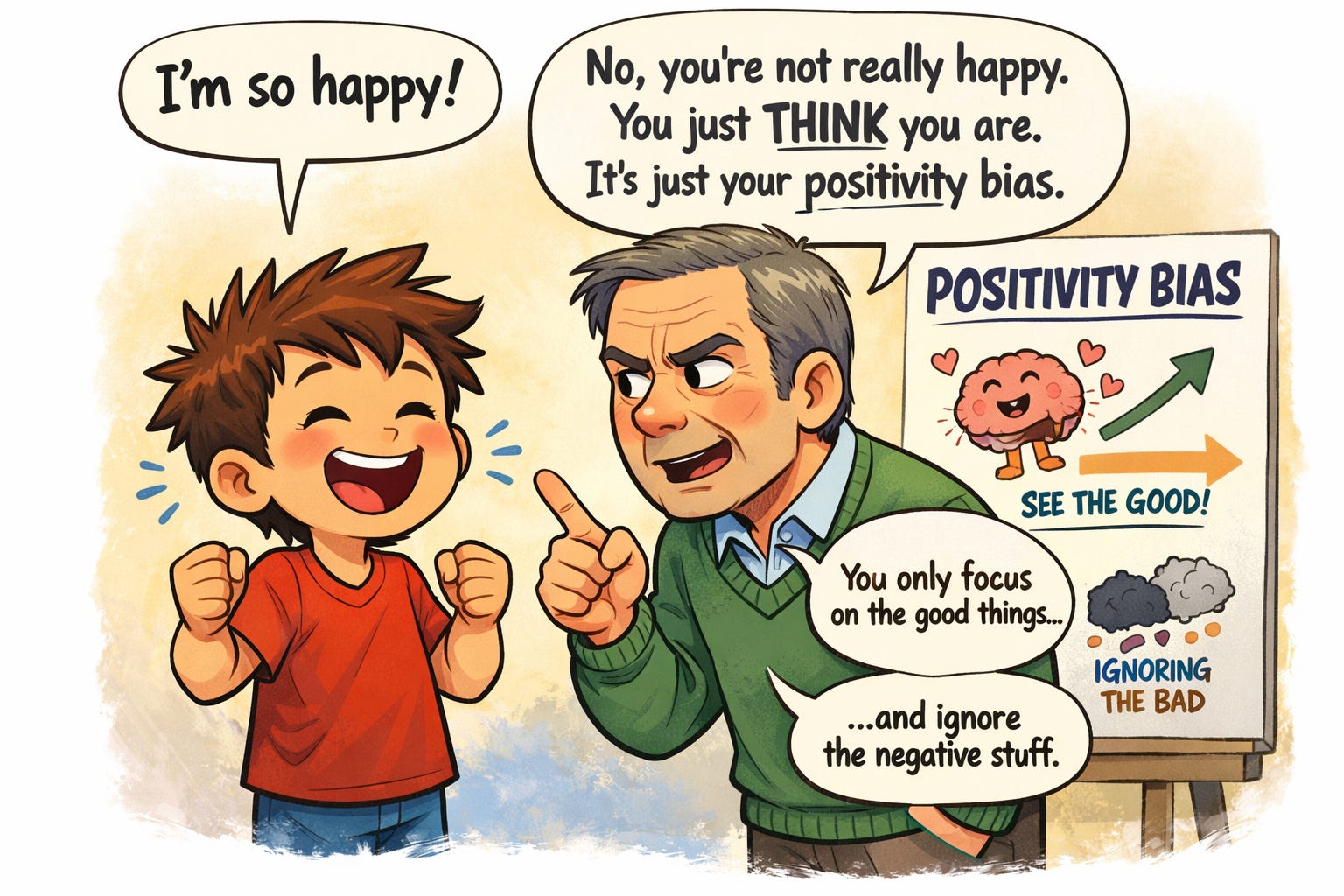
In chapter 3, Benatar goes on to argue that we are plagued with an optimism bias that makes it impossible for us to accurately ascertain how good or bad life is (and therefore, he suggests, offers a defeater to impression of the majority of people that they lead overall happy lives). This is distinct from his more throwaway line in chapter 1 about evolved pronatal instincts, as he points to ways in which our impressions are inaccurate, rather than undermining whether certain intuitions can be moral evidence. It therefore isn’t relevant to my above argument about intuitions and ethics.
However, I think it is worth dealing with this supposed defeater, since I can summarise the broad brushstrokes of my counterargument to this argument quickly. Benatar points out that we have a forward-looking optimism bias. But this doesn’t tell us anything about whether we are biased at looking at our mental states in the here and now. Benatar points out that we selectively recall positive memories. However, this does not mean that we overestimate how happy our lives are—rather, this recall bias likely makes us happier. Meanwhile, positivity bias in recall is not universal: the sad folks who claim, in cynicism, that they simply have a more accurate view of reality than others in fact tend to overestimate the bad in life. They are both sad and inaccurate! Benatar also points to the finding that people with depression are often more accurate in estimating their social standing than those without depression. But again, this tells us nothing about people’s ability to ascertain their own affective mental state! It just tells us that a bit of a positivity bias in our evaluation of our social standing likely has a protective effect on mental health—which still means better mental health!
Therefore, the biases to which Benatar appeals do not in reality give us reason to think that people are overestimating their own subjective experiences of life. Rather, it shows that a positivity bias seems to make people happier, and a negativity bias seems to make people less happy. Well, that isn’t really too surprising and I think it’s quite a jump to go from that to telling people who think they are happy that they really aren’t.
Many people, on hearing Benatar’s asymmetry argument, find something off with it, but struggle to formulate what exactly is wrong with it. Others, who share his clearly pessimistic and loss averse dispositions, find the asymmetry argument crystallises what they have often felt. I believe that understanding the asymmetry argument in terms of underlying behavioural dispositions solves this conundrum, and reveals the argument to rest on behavioural preferences, not moral evidence.
I’d query the extent to which this is even true, since some people do regret not having their own children. Further, it is easier to bring the existence of suffering people to mind than it is to picture potential happy people due to availability/presence bias, suggesting that we have reason not to take this particular intuition too seriously even if we accept it to be true.