
Yes, It Is The Phones

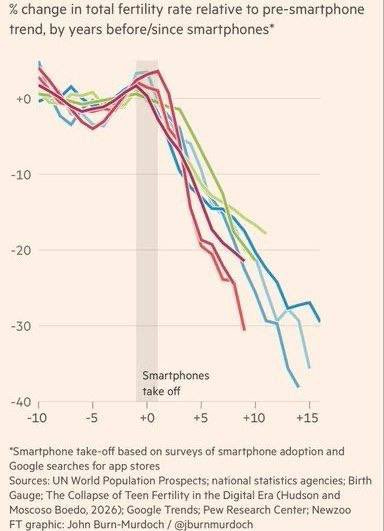
There’s been a great deal of discussion this week about the role of smartphones in driving down fertility after an article by John Burn-Murdoch published in the Financial Times 3 days ago showed that the timing of the fertility decline of the past ~20 years coincides with the take-off of smartphones pretty much regardless of when a country introduced them, as shown here:
This comes a couple of weeks after I suggested in a letter to The Guardian that, given the timing of fertility decline, smartphones are likely a big suspect (through their effect on romantic coupling), and linked to having forthcoming research on this.
My tenuous claim to fame aside, Burn-Murdoch’s great piece prompts many questions on which I’m currently working. A current working paper I’m hoping to release shortly deals with the question of which aspect of smartphones is really reducing fertility (whether easy access to porn, dating apps, social media or just the mere redirection of time away from socialising).
However, that’s not what this piece is about.
This piece is responding to the plethora of people coming out saying that it simply cannot be smartphones because the trend was already declining. Most notably on my feed, Dave Deek has repeatedly shared a number of graphs showing downward trends in TFR (such as the one below) and insisting that this implies it cannot be the phones. Dave is wrong.
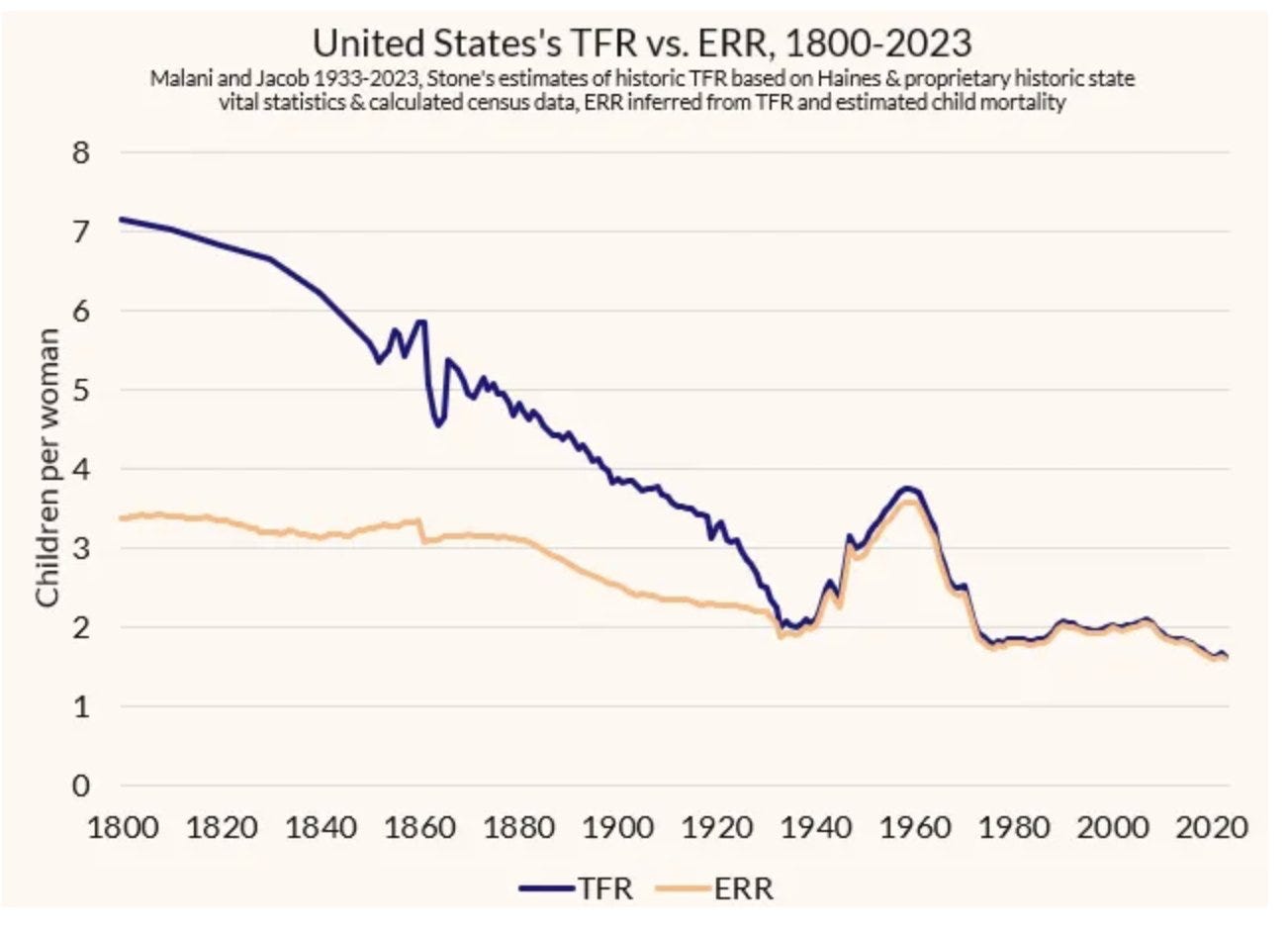
There isn’t a decline in decades previous to the introduction of smartphones. Rather, the graph that he shows has the beginnings of a decline in the late 19th century1 with what demographers call the demographic transition (or sometimes the first demographic transition), followed by a brief stabilisation, followed by the baby boom (that big bump), followed by a period of decline again (sometimes called the second demographic transition), followed by a stabilisation again and finally followed by a more recent decline yet again in the past ~20 years.
What occurred around the time of that most recent decline? Well, as John Burn-Murdoch has evidenced, it was the smartphones. Therefore, we are in a strong position to say that there is not some unrelenting consistent downward trend hurting fertility, but rather there is a new period of decline that has broken out across the world in the past 20 years, and that it has been highly correlated with the take off of smartphones whenever they have become common in a country.
PS. One thing that is particularly interesting to me, however, is that the pace of decline in different countries has varied a lot. For example, when it was introduced in the Faroe Islands (the subject of my forthcoming research with Kalina Aleksieva), their TFR declined much more rapidly than when smartphones were introduced in, for example, the US. I think this speaks to the idea that smartphones might very well act through multiple mechanisms. Faroese fertility was quite high for Europe and has, since the uptake of smartphones, trended more toward typical European levels, suggesting that there could be a culture spread aspect. Yet in countries with already-low fertility, their fertility dropped further still following the introduction of smartphones! This suggests that there is another causal mechanism than just cross-country culture spread, such as certain subcultures gaining more prominence or indeed non-mimetic factors, such as people simply spending more time at home and therefore having less time and opportunity to meet people.
I’m quite partial to the second explanation. I think that people have begun to approach in-person interaction differently as a result of the online life phenomenon. If I’m waiting around in an airport, I look around and all of these people who would have passed a dull moment striking up a conversation are instead looking down at their phones. I talk to friends and acquaintances and urge them to go out and meet people at pubs and bars and they seem to think that as long as they are connected online, it would then be inappropriate or fruitless to think about meeting people in person. Not that it seems to be working for them.
After adjusting for child mortality (see the yellow line).
Fascinating. What exactly are smartphones effects on romantic coupling? (Also what's the definition of romantic coupling lol)