
Women's Earnings Have Null or Positive Effects on Fertility

This is a topic I’ve come back to a few times, as I’m interested in the relationship between earnings and fertility. It’s a great topic, as there are many myths. Some think that rising income causes low fertility, just because they are correlated. I put out a working paper in January showing that this is simply not true. Income raises fertility. But another great myth is the claim that women’s increased earnings is behind the decline in fertility. This is repeated super-often, and not just by misogynists on twitter! So, it is worth taking the time to show that it is simply false! Women’s earnings literally do not matter for coupling and are probably slightly positive for fertility.
Firstly, let’s consider perhaps the major reason people even think that women’s earning potential harms fertility in the first place: the timing. Female labour force participation and earnings began to increase in the ‘60s and ‘70s, and fertility went through a decline around the same period. But let’s look at the trends:
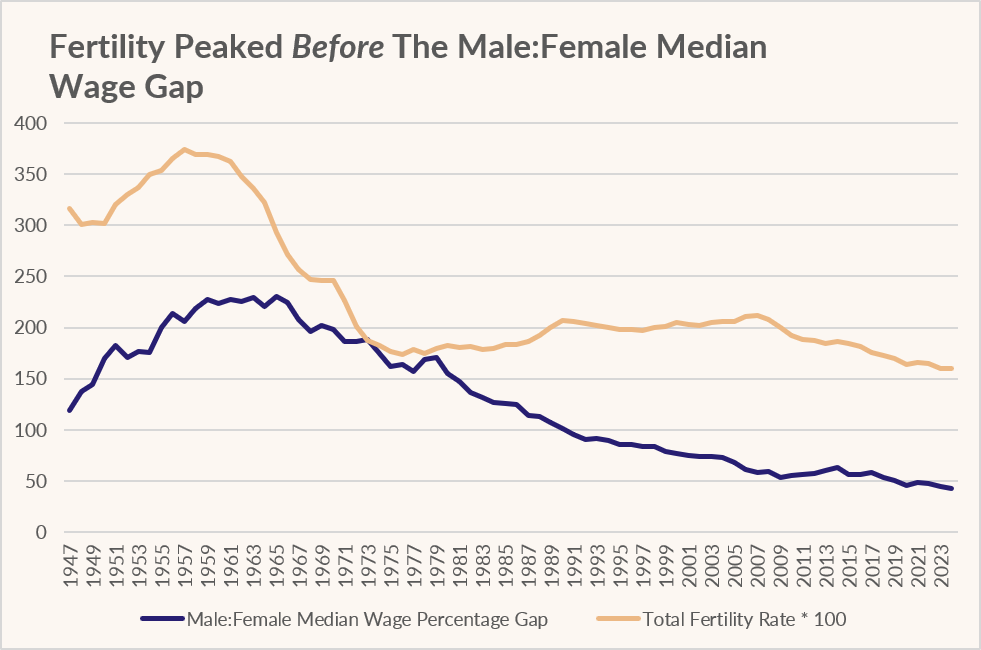
As it says in the title, fertility peaked in the US before the male:female median wage gap did. If sex wage gaps really were the big determinant behind declines in fertility, we would expect changes in the wage gap to precede downward changes in fertility, but we actually see the opposite: fertility starts to decline in ~1960 and then the wage gap starts to decline. Perhaps the wage gap went down because family life was being delayed so women were securing more wage gains in the workforce. Just a thought!
Also interestingly, the wage gap continued to fall even after fertility began to slightly rise in the ‘80s, and then, as the wage gap finally stabilised, fertility began to fall. If anything, the relationship is the opposite of what one would expect! So, it’s dead in the water as a contender for being the main explanation of fertility trends in the postwar period.
Of course, not being the main cause doesn’t mean that it’s not a cause. So let’s deal. Firstly, as mentioned above, it’s worth pointing out that income, in general, raises fertility, as I argued on the IFS blog and as Lyman Stone has also evidenced. More money, more babies, makes sense. But let’s break it down by sex.
When men win the lottery, they are more likely to get married, less likely to divorce, and more likely to have children (good stuff). Some have reported that, when women win the lottery, they are more likely to divorce and have fewer children. Those people have not read the study properly! In a Sweden lottery winnings study, once you look 5 years out, there was no significant effect of a woman winning the lottery on divorce and fertility. The effect on divorce purely lay in a 2-year time horizon, suggesting that the money just meant that women who would’ve left at some point did so sooner.
This was replicated in a similar study looking at lottery winners in Taiwan 6 years after their win. In the Taiwan study, the women winners had a non-statistically significant lower chance of divorce following their lottery win. They also did not have a statistically significantly different chance of having married, whilst men’s chances of getting married went up. In short, it looks again like women’s material conditions actually do not hugely matter for coupling.
A longitudinal study looking at divorce risk found similar results for employment status to those found from the lottery winnings papers. Men’s employment status mattered for their risk of divorce (as you’d expect, a husband’s unemployment increases risk of divorce), but women’s didn’t make a difference either way.
There was a working paper out in December which went viral in ~January claiming that women’s income negatively affects fertility by looking at changes in tax bands in Denmark. The problem is, people knew the tax reforms were coming (they were phased in over the course of a decade), so could move their fertility and labour participation accordingly. Lower fertility and more working around the timing of preferable tax regimes is therefore exactly what one would expect from just reasonable timing changes.
If you want to look at the effects of changes in women’s wages on fertility and coupling, you should look at an unexpected downward or upward shock to their earnings potential which happens without being in the context of changing social norms. I don’t think we have any such cases. But perhaps we can look at something close-ish to that. Prior to 1980, US female median wage growth was sometimes higher than men’s, sometimes lower. In 1980, the era of ‘comparable worth’ assessments of female earnings began (in the pursuit of ensuring wage equality for equivalent work), and female median wage growth began to consistently, year after year, outstrip male median wage growth. This continued until 1993. What did we see in the 1980s? The only period of over-5-year consecutive growth in American fertility (1983-1990) seen since 1957. Granted, other things were changing in the 1980s.
So, let’s get into more specifics. In 1981, a legal battle over comparable worth began in Washington State. Oregon only made a legislative reform for comparable worth in 1987. So, did these states, which had near-identical fertility trends in previous years, see a divergence in the years in which only Washington State had live efforts to raise female wages?
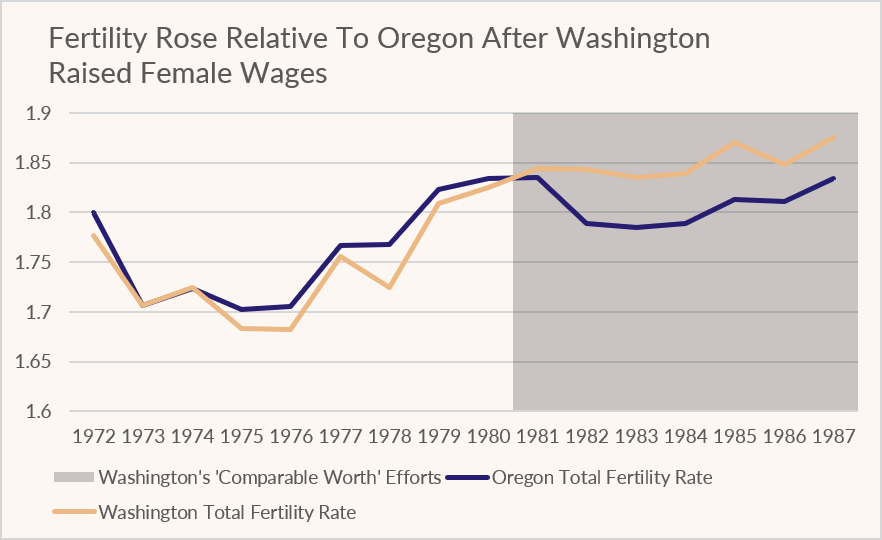
But what happened after Oregon got onboard and introduced its own ‘comparable worth’ legislation in 1987?
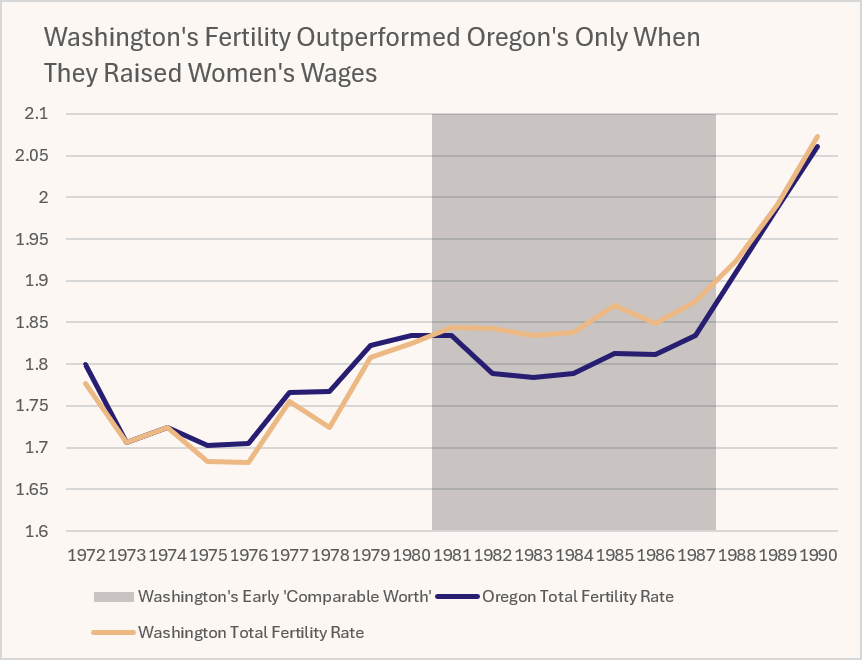
None of this is a rigorous difference-in-differences (DiD) causal analysis, although I ran my own beta version of DiD in a spreadsheet and got significant positive estimates.1 It is pretty striking that we see it behave in this way, even with the consistency with the prediction given that they re-converge after Oregon catches up. This is suggestive evidence that women’s wages, if anything, act slightly positively on fertility. At any rate, there certainly isn’t a a negative effect in this case.
So, like I said, women’s wages do not matter for coupling and might even be positive for fertility (but not negative).
What About Female Hypergamy On Income?
There is a well-repeated line that women are hypergamous, i.e., that they seek men who perform better than themselves. When we look at who people actually pair up with, we see that a lot of coupling is assortative (i.e., with people who have similar characteristics). People tend to couple up assortatively on education and height (after adjusting for sex-differences in height). But on income, we still see ‘hypergamy’.
But even though women tend to be with men who earn more than themselves… that doesn’t actually automatically mean that this is important for coupling and for couple stability. This is especially true since women often take a step back when having children, which near-automatically results in an average earnings differential amongst couples.
What we’ve seen evidence for is that a guy really should be holding down a job and have some money to get married and stay married. We’ve seen a conspicuous absence of evidence that women need a high wage differential to couple up with a guy.
I’d venture to suggest that there isn’t really ‘female hypergamy on income’, but there is a ‘having a job and some money set aside’-amy going on.
What Does This Mean for the Discourse
There’s almost a horseshoe of opinion on this: there are those who blame the decline of the family on women’s earnings and want to turn it back, and there are those who think the decline of the family is just the natural result of women’s earning power and choice. But neither seem strong on the empirics: when women’s earnings went up with reasonably stable men’s wages, fertility actually rose.
What Does This Mean for Policy?
Men’s employment and material conditions do affect coupling and fertility, but on an absolute level, not a relative one. Ensuring that young men are doing well is very important—but the answer is not to do it at the cost of women’s choices and prospects.
PS. Where, I hear you ask, did I get such marvelous state-by-state year-by-year fertility data? Lyman Stone’s IFS Fertility Database Explorer of course.
I did run a little spreadsheet exercise in which I took, for years 1972-80, the variance of the gaps between Washington and Oregon TFR and the average of the gaps to give an estimator on the simple function:
Washington TFR at time t = intercept + Oregon TFR at time t
And found intercept = 0.002381 (0.013541)
Such that I could then work out predicted values of Washington TFR vs actual values to give a causal estimate (below), finding that my back of the envelope workings suggested a statistically significant deviation.
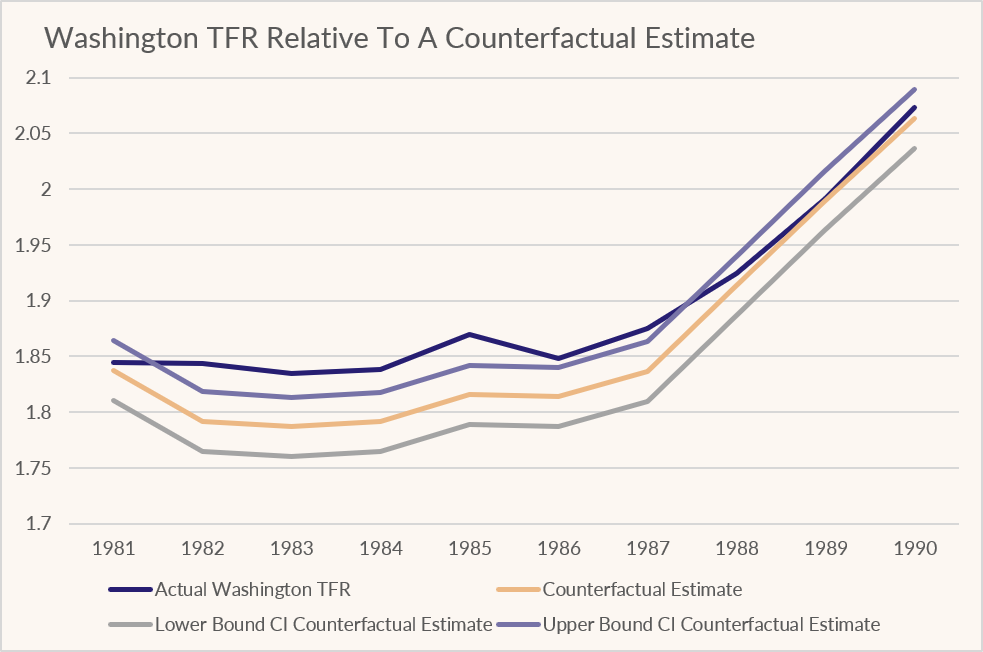
This isn’t strictly a DiD, which uses OLS, but I think it has an identical intuition.
In my looking into this I got the impression that only married male after tax income really moves fertility.
One mistake that places like Hungary made is that they spent a lot of money on subsidizing female income and consumption. They offered zero tax breaks for married men (no married filing jointly) and even had marriage penalties in some cases.
By contrast France before 2015 had pretty robust family benefits, including a formula for determining income taxes that rewarded large families and had a married filing jointly system. They had replacement fertility back then.
I don't think female earnings HURT fertility, but I'm not convinced it raises it. Hungary completely eliminated income taxes for women with lots of kids and it was a dud. What woman trying to raise a bunch of kids also wants a high stress career? And of course all those kids need to be raised in daycare which is expensive.
The solution is large payroll reductions for married couples with kids. The spouses can sort out how they want to generate the income, we just need to insure they keep more of it.