
The Liberal Happiness Gap: Maybe You're Just Single

Richard Hanania has claimed, on the basis of twitter/X polling, that the the conservative-liberal self-reported happiness gap almost entirely goes away when you account for belief in therapy culture. According to other research, the decline in self-reported happiness can be almost entirely attributed to decline in marriage. In this post, I replicate some of Hanania’s results with a less vulnerable-to-bias survey sample (the GSS), but I also found:
The liberal happiness gap is just a singlehood happiness gap
Marriage has a 2.5 times greater association with happiness than my proxy for therapy culture
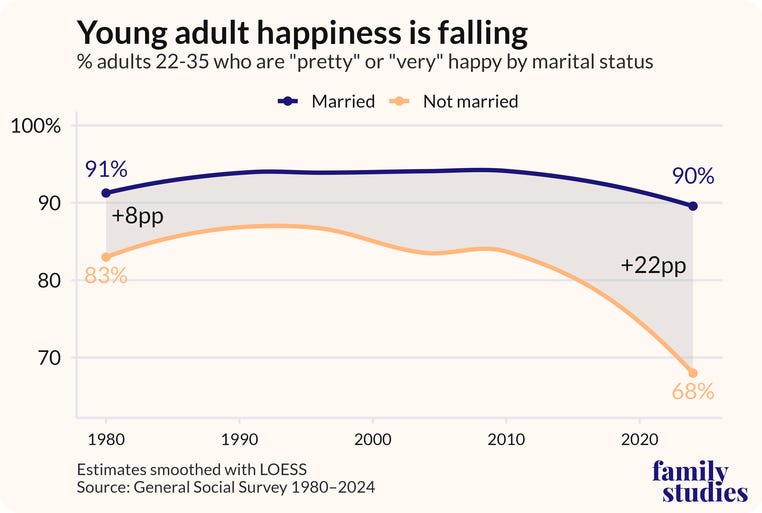
Some circumstantial evidence that something important is going on with respect to happiness and marriage can be found in the fact that growing unhappiness amongst young people is limited to the unmarried:
I wondered if the strong associations between both marriage and (in Hanania’s one investigation) therapy culture might be explained through therapy culture predicting marital status, which in turn predicts happiness (e.g., through combatting loneliness).
A quick and dirty way to hack this is to look at correlations in a given period of time, after controlling for other variables. This doesn’t provide strong evidence of causation, but it does tell us if variables are even associated, and so gives suggestive/indicative evidence.
In the latest year with available data, 2024, I used self-reported likelihood of taking a child to a psychiatrist when worried about them as a proxy of therapy culture. It’s not perfect (some are into therapy but hate psychiatry drugs), but at least it gives an indication of ‘takes mental health seriously as a medical problem worth checking in a given case’.
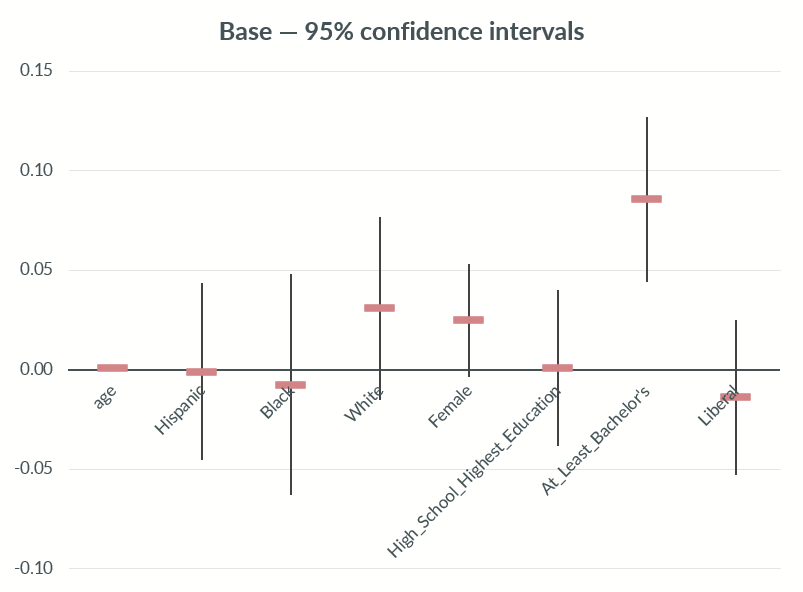
I have been told graphs and charts are nicer than regression tables! So here’s one below. In the basic model, before adding my proxy for mental health culture and marital status, the significance of the liberal happiness deficit already goes away when doing basic controlling for age, race,1 sex, education and ethnicity. I strongly suspect that a good chunk of it has been absorbed by age:2 as people live more, they acquire social connections and responsibilities which often make them more conservative and more happy.3 If I’m right that the age benefit for happiness has a lot to do with social connection and responsibility, then we would also expect adding marital status into the model to reduce the association between age and happiness—we’ll see later.
When I added the mental health proxy to the model, these were the results:
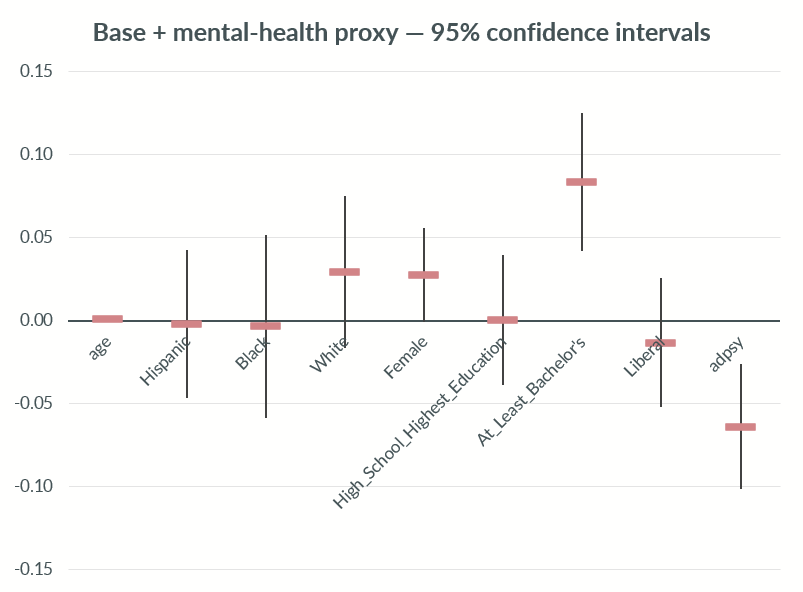
So, Hanania’s result replicates. Being more likely to jump to taking a child to a psychiatrist is significantly associated with a lower chance of reporting oneself to be happy.
When we add marriage, we see a couple of interesting things:
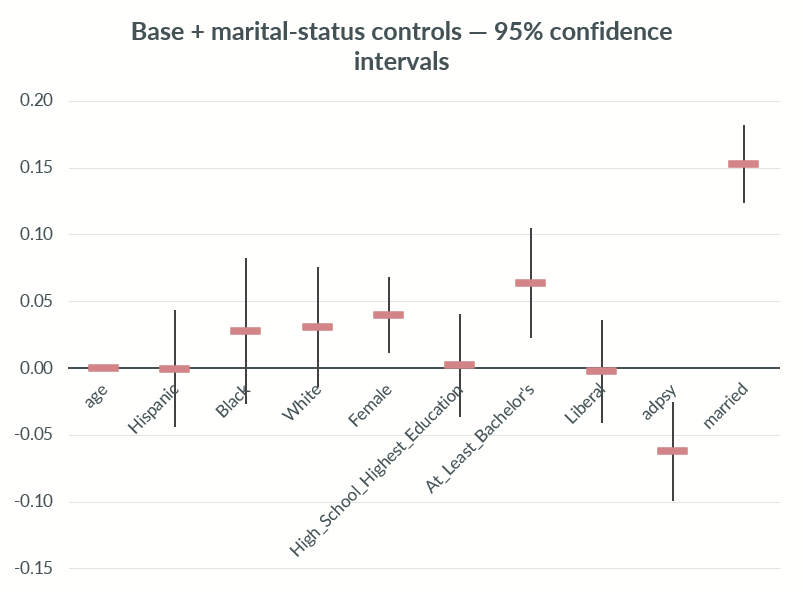
Firstly, adding marriage does basically nothing to the association between mental health culture and happiness, so it doesn’t look like my thesis has legs there. Secondly, adding marital status makes the liberal happiness gap basically go away and robs age of its statistically significant association with happiness.
In short: the liberal happiness gap exists pretty much entirely because many liberals are young adults void of intimate human connection and responsibility.
I avoided perfect multicollinearity on the race controls since there are racial groups other than Black Americans, White Americans and Hispanics, although I concede it makes the base group ‘Other’, which might not be the best representation—but I leave it as is since they’ll do fine as controls/it’s not what I’m investigating.
It’s worth noting that the chart under-represents the impact of age. That line raised only slightly above the 0 line is statistically significant and gives the estimated increased likelihood of reporting feeling pretty happy or very happy per extra year of life. But people live for decades!
They also acquire, on average, more financial security, which also helps.
Feminism