
Stephanie Murray Highlights

Stephanie H. Murray of Family Stuff fame has written a great many newsletters giving summaries and her own analysis on research related to all things family. In her tour de force, a few things in particular grabbed my attention for their practical policy implications, so I thought I would run a quick highlights post for bits which most directly touch on the things that interest me and lay out some of my thinking on them. I’ve not spoken to her about doing this in advance, but I endeavour to do a reasonable job!
Female Income & Fertility
Murray reports on a paper (Donald et al., 2024) which finds that, when sub-Saharan women’s income increased, they had more children. This provides further evidence that the negative effect from the opportunity cost of wages foregone — which I accept to be a thing (see below) — can be outweighed by the positive effect on fertility of simply having more money.
Fertility Gaps and Compensating Lost Earnings
Highly educated women tend to have a larger ‘fertility gap’ (the gap between the stated desired number of children and the actual number of children born (or rate thereof)) in the UK and the US. This suggests that the education-fertility link isn’t purely about those who favour education and career over family making their choices, but rather educated women facing larger frictions to realising their desired family, such as an increased opportunity cost.
In Germany, the state responded actively in 2007 with a generous maternity benefit which set maternity benefits (above a minimum) to 67% of a women’s income immediately prior to having a child. This hugely offset the financial opportunity cost of having children that is greater for higher earning women. Raute (2019) found this reform raised fertility of university educated women by a quarter over the course of a 5 year period. The policy cost less than half of what the UK state currently spends on subsidising childcare, which in turn is less than the current extra annual spending on the UK state pension as a result of the ‘triple lock’ policy which causes the state pension to rise even in times of low wage growth and low inflation.
We see a similar pattern in general. Whilst the UK and the US, with restrictive welfare states generally meaning that welfare only supports the families of the less well-off, have lower fertility amongst university educated women, Scandinavian countries, with generous support for family formation for the educated, report slight higher fertility amongst educated women. In short, countries that compensate disruption to employment from childbearing don’t see a reduction in childbearing with employment. (More papers for this also signposted in Murray’s piece.)
Implication: there is a lot of cost-sensitive desire to have children if lost earnings are better compensated.
Environmental Pressures & Children
Turns out that we can produce enough food sustainably to feed a growing population (Lam 2024)!
Maybe A Purely Speculative Paper Was Okay After All… Maybe
In a working paper out last year, the Nobel-winning Claudia Goldin argued that the gap between southern Europe and East Asia relative to northern Europe and the US fertility could be due to rapid economic growth leading to changing norms about gender and formal labour force participation not matching changing norms about the home. This, the argument goes, incurs high costs on women for forming families, as they are expected to keep up their professional performance and take on the lion’s share of the housework and child rearing.
I was slightly annoyed that this working paper, which is entirely speculative (and which Goldin herself concedes at the end of the paper to be one explanation amongst several), got so much uncritical traction in much of the media. A good story wins in popular perception sometimes just by virtue of being a good story. My general view is that the paper only offers half of the story. One half, which the paper talks about, is just the straightforward effort:reward ratio of different offerings (with societies that have patriarchal norms in the home and feminist norms in the labour force offering uniquely bad effort:reward outcomes for women). But the other half is about what we value, or what some call status effects (although I personally think people are driven by internal moral sentiments in addition to status/perceived external moral sentiments concerns). There are also wider challenges in southern Europe and East Asia, from economic stagnation in the former to distinctive approaches to formal education and career signals in the latter.
When one is faced with 2+ explanations of something, it is likely that the overall cause is some mix of the two explanations. But that doesn’t really tell us much. Could the result be 2% caused by explanation X, 98% caused by explanation Y? 98% X and 2% Y? 50:50? 30:70? 70:30? Who knows! Below is a look at two papers Murray highlights. Also, side note, these papers predict Goldin’s paper.
Leocadio (2024), when you go through their results:
Failed to find significant effects on general intentions from housework equity in all countries but Russia and France, which is pretty interesting.
Found statistically significant positive effects on fertility intentions from childcare equity only in Belgium (eurocrats ftw). This is looking at 10 countries in Europe (if one includes Russia and Georgia). Note that it wouldn’t be that weird to get a fluke statistically significant result from a sample of 10 countries using the Fisherian 5% significance level.
Took their headline results from their model in table 2, but table 3 had the results with relevant controls, and failed to find much. Now, to be fair, one can pretty much destroy any result (hyperbole) by flooding control variables into your model until each control has a tiny estimated causal effect. But these were quite reasonable controls (things like age, education, and so on), and I highly suspect (although they don’t show whether they tested this) that each added variable would have passed an F test on improving the fit of the model in a statistically significant way.
Goldscheider et al. (2015) notes that men’s role in the household is playing a sort of catch up with women’s role in the formal labour market, with a gradual catch up. Together, these two papers show a) that men’s role in the household seems to either lag or be unrelated to increased female formal labour force participation, and b) that this may have a significant effect on fertility intentions.
The main challenge to this view is that the models didn’t find hugely significant effects from the amount of work spent on these things and fertility intentions. It seems that maybe household preferences are sufficiently varied to avoid a simple relationship here. A crazy idea I have is that letting households work out the optimal split of duties that works best for them might end up being the best approach, rather than some ideological bureaucrat (whether believing themselves to be a good trad or believing themselves to be a good feminist) dictating from on high. Murray has written about this herself on the issue of mandating a split of parental leave — and I’m particularly concerned about the implications of forcing both parents to take a financial penalty in having children given this is a de facto increase in the financial burden to the household from having children. (Note again: my ideal parental leave policy would be to let couples entirely choose how they wish to split the leave allowance.)
Therefore, I remain a bit sceptical of the Goldin hypothesis being the main driving factor, although a major limitation of my above critique is that the 2024 paper examined the ‘intensive’ margin (i.e., the question ‘do we/I have another kid?’) vs the extensive margin (‘do we/I have a first kid/do we become parents?’). Since a large chunk of fertility decline is a problem of childlessness, it’s possible that anticipated labour distribution does affect how much women marry and become mothers, even if the effect on whether they have a second child is weak.
(By way of illustration of the problem of falling fertility in East Asia being one of childlessness, from 1980 to most recent data, the fall in TFR in Japan was 34% and the fall in the Total Maternity Rate (TMR, the proportion of women who would become mothers at period rates) was 30%, the fall in TFR in Taiwan was 63% and the fall in the TMR was 45%; in South Korea (with less data), the fall from 2000 was 51% in TFR and 39% in TMR. That is to say, the majority of the decline really can be accounted for by declines in people making the transition to parenthood.)
There doesn’t seem to be an easy way to credibly analyse this, so I remain of the opinion that the Goldin analysis is probably accountable for somewhere between 10 and 60% of the extra low fertility in southern Europe and East Asia.
Implications From Birth Order
There is a well known relationship between IQ and birth order replicated a number of times. Each rank lower in birth order predicts a fall in IQ by an order of about 1.5 points. There is debate about what causes this. A degree of it is likely genetic as mutational load increases with age. Another possible aspect of this is parental attention. But an interesting study shared by Murray finds that 20% of the income disadvantage with birth order gets passed on. The income of 3rd born children is 3 percentiles lower than that of first borns, and the children of 3rd borns perform 0.6 percentiles worse than the children of first borns. Unlike many other outcomes, shared/parental environment/upbringing does matter for adult income, so I can’t really say what the big driver of this is.
In The Case for Having a Baby in College, and Other Interesting New Research
Having Extra Siblings Doesn’t Negatively Affect Those Already Here
Also in The Case for Having a Baby in College, and Other Interesting New Research !
A working paper with Danish data used randomness of IVF success to test for an outside/exogenous shock on whether a family had a second child whilst keeping other variables (such as desire for a second child) constant. First-borns scored the same on maths and reading tests, big 5 personality traits and school happiness regardless of whether they had a second child. This is consistent with other research on birth order outcomes, in which first-borns with siblings end up with similar earnings and intelligence advantages over the general population as only children.
Some research claims that adding siblings hurts outcomes, but what they really find is that later-born children tend to have worse outcomes. First-borns have similar earnings and intelligence outcomes regardless of whether they have siblings, and so on. The quality-quantity tradeoff talked about all the time by population economists and commentators just isn’t born out of the data! Ironically, it’s probably the idea of the quality-quantity tradeoff that makes some act as though it’s true.
Murray on The Case for Having a Baby in College
On another Danish paper! And from the same article as the two above! Was a strong one!
As discussed above, fertility does seem to be sensitive to the opportunity cost of lost earnings. I agree with Lyman Stone that fertility trends in recent years are mostly about marriage and coupling more generally. But — and I think he would agree — this doesn’t mean that opportunity cost of earnings doesn’t matter at all, and we see an indication of this in his own work collecting studies on financial support for family formation, which includes measures designed to minimise the financial opportunity cost of having children (such as the one studied in Raute 2019).
So, whilst I do not for a moment believe that eliminating the financial opportunity cost of having children would be sufficient for a country like, for example, Italy to raise her TFR to stated fertility ideals, I do think it would create a significant narrowing of the gap.
The question of financial maternity penalties is thus very relevant for thinking of policy and lifestyle with an eye to achieving family goals. This very interesting working paper shared by Murray looks at the trend in average earnings for those who never became mothers, those who became mothers after they completed their education, and those who never became mothers:
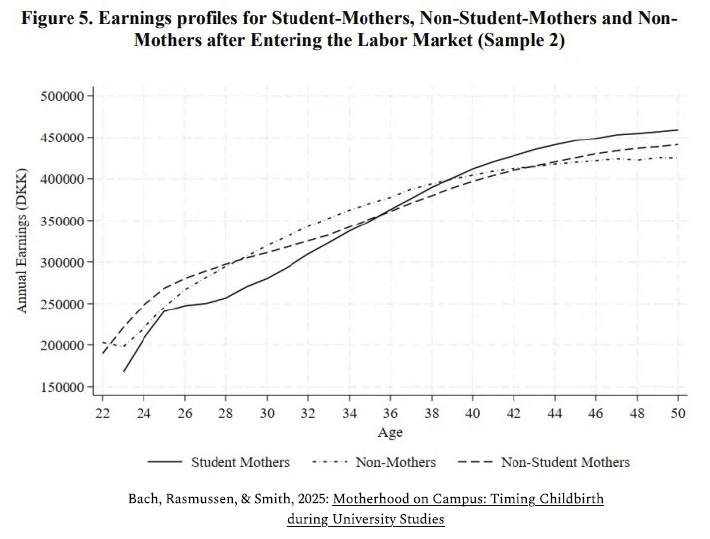
What a crazy result! The student mothers’ earnings exceeded those of even non-mothers by their 40s. We also see non-mothers earnings fall below those of women who became mothers in the labour market. There seem to be two obvious potential explanations for this: 1) whilst mothering could have negative earnings effects in the early years, having a family might have positive effects as the children are growing up, 2) there may be selection effects in which those who become mothers are on average better equipped for earnings growth in other ways.
I think both are plausible. Having children is quite correlated with having stable coupling, and there is a lot of literature discussing the potential benefits of having spousal support and access to the benefits of specialisation within the household. Having children is plausibly a source of motivation for contributing to the provision of a better life. Further, navigating close family relationships may cultivate transferable relational skills. These points both favour the idea that family might be causally positive on earnings growth once children get past a certain age. But a point in favour of a selection effect might include that, since having children is correlated with stable coupling, those who realise family behaviours may well on average have already cultivated beneficial temperaments and relational skills that support earnings growth.
I also think that the student mother advantage in the 40s might be causal — children already more grown up + all the causal explanations above — there could also be an additional selection effect. Many women, upon having children whilst in formal education, drop out. Those who continue to finish their studies are the ones with the earnings advantage in their 40s. So, the study likely selected in favour of those who have family support and/or a sufficient mix of determination and intelligence to complete studies whilst raising young children.
So, it’s a bit premature to say that we’ve found that supporting and recommending women to have children whilst in formal education is likely to raise their earnings in the long run. But, it is nonetheless a very interesting data point. Also, the student mothers had higher completed fertility!
It does make me wonder what a policy that tries to minimise the downsides of having children whilst in formal education and maximise the upside might look like. In the UK, we have student maintenance loans. An equivalent add-on loan could be introduced for supporting children, in addition to other support. The simplest measure would keep the loan at the same interest rate as other student loans (typically RPI inflation + 3 percentage points), but a more subsidised measure could include a lower interest rate. There would be a perverse incentive if this was introduced in the context of the current UK university system, in which around half of university places are net negative for the Treasury on a static analysis (i.e., the students aren’t paying off their loans), and therefore some may be incentivised to start courses they never intend to complete so that they can garner support for having children. However, this could play a part of a wider reform of government-subsidised student loans to ensure that the courses being supported will still be of economic value. Such a reform could also release the funding for this measure.
Another easy way of supporting student mothers within the current system would be to give rights for parental leave explicitly (which are currently only incidentally covered by the Equalities Act) and to also introduce the right to part time studies. Most universities in the UK are public universities, so such measures shouldn’t really raise concerns about regulating a private sector if only applied to public universities.
Expanded Child Tax Credits & Substance Abuse
Many worry that increasing cash support for parents will result in misuse of funds. These worries are often particularly common with respect for low income parents. So, what did the expansion of the US child tax credit do? Use of alcohol and illegal drugs stayed the same. Tobacco use actually went down!
This result is less surprising than many may think. Tobacco use is linked to stress, so the easing of parents’ financial worries may increase the will to cut back on smoking. And other drugs, including alcohol, are often used habitually, and so are likely less income elastic than many assume.
what an amazing newsletter to see pop up in my inbox hahaha I was so confused for a minute!