
Low Birth Rates Won't Correct Themselves Genetically - Contra DeepLeftAnalysis

Will low birth rates correct themselves by genetics? Has France recovered by virtue of natural selection?
Well, the French example is interesting as they went through the first demographic transition to lower birth rates before any other European country. By the by, going through this demographic transition precipitated a loss in geopolitical and economic power of huge historical importance – hence the language of the world being English rather than French. So, yes, low fertility does seem to be a societal problem!
According to DeepLeftAnalysis🔸 , France has higher fertility than most of the developed world because, in a low fertility society, those with genes for broodiness will people the earth. France, going through the first demographic transition to lower fertility earlier than anyone else experienced, according to DeepLeft, high selection for broodiness genes which now supposedly pervade across the French.
Very interesting hypothesis, and it is hopeful for the future of society – it predicts a natural bounceback. Bryan Caplan of Selfish Reasons To Have More Kids fame has suggested something similar, saying that given the right time scale fertility will have to bounce back as genes that code for broodiness grow.
Great theory, happy days, problem solved. Except it just doesn’t fit the data.
I’m a big believer in the gene thing and its relevance. There’s a lot of nonsense out there denying that intelligence is significantly heritable, for example. Silly. However, that does not mean that all things follow a simple hereditary line. The fact is that different genes code for how many children you have across different times and cultures. For example, in the West today, neuroticism negatively correlates with your number of children. But in Africa, it positively correlates – particularly in polygynous households (evolved resources-grabbing through anger/upset?). The same can be true of intelligence. Where intelligence massively predicts formal education, it hurts fertility (because formal education hurts fertility and/or the culture around formal education hurts fertility). Where intelligence predicts earnings by even more than it predicts formal education, it can help fertility, because income (once controlling for careerism and education) positively predicts fertility. The highest fertility people are low education highly successful men.
It is so pervasive that different genes predict fertility in different contexts that the only genetic traits that have been consistently selected for in the past few thousand years are for height and weight (those with a lower propensity for obesity and a taller figure fared better in surviving offspring). This says something about the idea of there being simple genes for broodiness that just need to fight it out on the differential fertility marketplace.
But maybe France is special? Nah. If we were expecting fertility to have bounced back due to genetic factors that can be mapped along a continuum, then we would expect the rate of fertility decline to have slowed, bottomed out and then begun to rise. That’s not what happened. Rather, French fertility began to rise directly in proportion to policy interventions and a cultural awareness of the issue. Admittedly, much of this was new to me until hearing it from Lyman Stone four days ago.
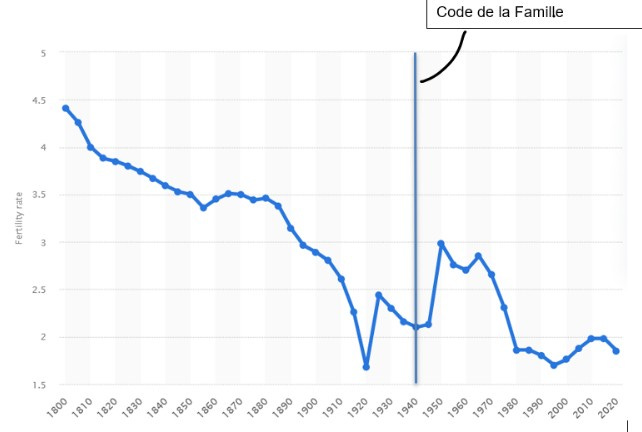
[I hope you like my beautiful graph.]
But… but… but what about if it was real? After all, fertility is heritable because in any given set of societal conditions, certain traits predict fertility more than others. Tall people are more attractive in European society – particularly in Dutch society. Intelligent people tend to get more formal education and more money in modern society. The list goes on. If the societal conditions are constant enough, then we would expect fertility to bounce back somewhat as the genes that increase fertility conditional on our societal conditions become more common.
There are two big problems with this view. 1) Persistent low fertility has pretty big implications for societal conditions, so it’s not at all obvious that the genes that boost fertility today will do so tomorrow. 2) It ignores social norms.
Allow me to explain (2) properly. Again, I accept the reality of heritability as much as the next guy (well maybe not that next guy). However, social norms are pretty damn important too – and work as complements, not substitutes, to genetics. For example, if you have norms in your society that reward people for being smart, then smart people spend more time trying to become smarter and people less smarts inclined make sure that they at least satisfice some base level of smarts to operate in society. The norm does not somehow compromise people’s natural propensity to smartness – which it would if you thought that norms were competing with genetics.
Now let’s talk fertility, norms and genetics. People shape their fertility with respect to norms. It used to be the case that, if you quite liked kids and were inclined to have the higher end of average, you’d have four at an earlier time in 20th century. As the first demographic transition completed across the developed world throughout the 20th century, that translated to three. Whilst ideal family size has been remarkably constant in the past few decades in the developed world, changes do happen. So, even those genetically predicted for higher fertility often have only slightly higher numbers of children than others – and so the rate of evolution isn’t necessarily particularly notable – even given constant societal conditions.
To be fair, the big mechanism by which fertility is declining in the developed world today is in rising rates of unplanned childlessness, as documented by Stephen Shaw. Those who are childless do have significantly different fertility than those who have children – by a factor of infinity. So, I do expect there to be some trends in genetic make up of the population. Neuroticism is the big casualty as mentioned.
On the flip side, the fertility differential between the university educated and others is also pretty sizeable. Although childlessness rates are converging by education (and in some places have flipped), family size norms are admittedly lower amongst the more highly educated.
So, I do expect some trend changes in traits of disposition to be educated and neuroticism, amongst others. Note, however, that this does not mean a fertility bounce-back is in the works. When the norms change, people change too. When the standard life course of a culture or subculture – e.g., delaying parenthood very late – gives one a high chance of childlessness, then your low neuroticism won’t matter as much as you think (probably also because you’re a chill, non-neurotic person).
We are social creatures. Our ability to respond to norms – and to be vicious in enforcing them – is awe-and-dread stuff. A few changes in some psychological traits is not going to shift the fertility needle – ultimately, societal conditions will matter.
Therefore, all of norms, values and policy are relevant. France doesn’t have the highest fertility in Europe because of genetics – it’s because of pronatal policies and family norms. What’s the lesson for the rest of us? Family friendly policy can make a meaningful difference – and putting your hopes in some heritable bounce back is faith in nature beyond and despite what the evidence says.
Late commenting here, but this is all excellent reasoning, agree with all of it.
I believe there WAS a selection method for pro-natal norms for nearly all of human existence, but it was mostly social/cultural, not genetic. See Robin Hanson's idea of cultural drift. Anti-natal tendencies were extinguished at the level of tribes, clans, villages, etc. Not individuals (for the reasons you describe here), but also not entire empires or kingdoms, because anti-natal ideas couldn't spread that far before they consumed their host.
In the past, as soon as some group or other started to drift too far in the direction of anti-natal norms -- even just a trend towards too-late marriages or getting too picky over spouses or something -- that group would be swiftly annihilated through some combination of natural causes and the encroachment of other groups unless it corrected course almost immediately. Keeping in mind that replacement TFR under pre-20th century death rates might be ~4, so a trend towards even ~2.0 TFRs back then meant your supply of prime-age men would utterly collapse in a matter of a few decades.
Long lives and low death rates have allowed anti-natal norms to take root more deeply and to diverge further from pro-natal traditions than was ever possible in the past, while mass communication technologies have allowed these norms to be advertised and glamorized around the world, converting pro-natal cultures to the more glamorous norms faster than they can replace and extinguish the anti-natal cultures.
So this old selection method is probably gone forever. Or if it returns, it will look very different and operate on a far larger scale than in the past.
I was surprised to see that fertility rates in France are picking up. How much of that increase is among the indigenous French population and how much is attributable to ehtnic communities in France? Immigrant communities account for around 20% of the French population so the higher birth rate in those communities may only have a fractional effect on the fertility rate, but if that higher birth rate continues it will (surely) have a multiplier effect and will eventually impact on the fertility rate