
IQ & Income

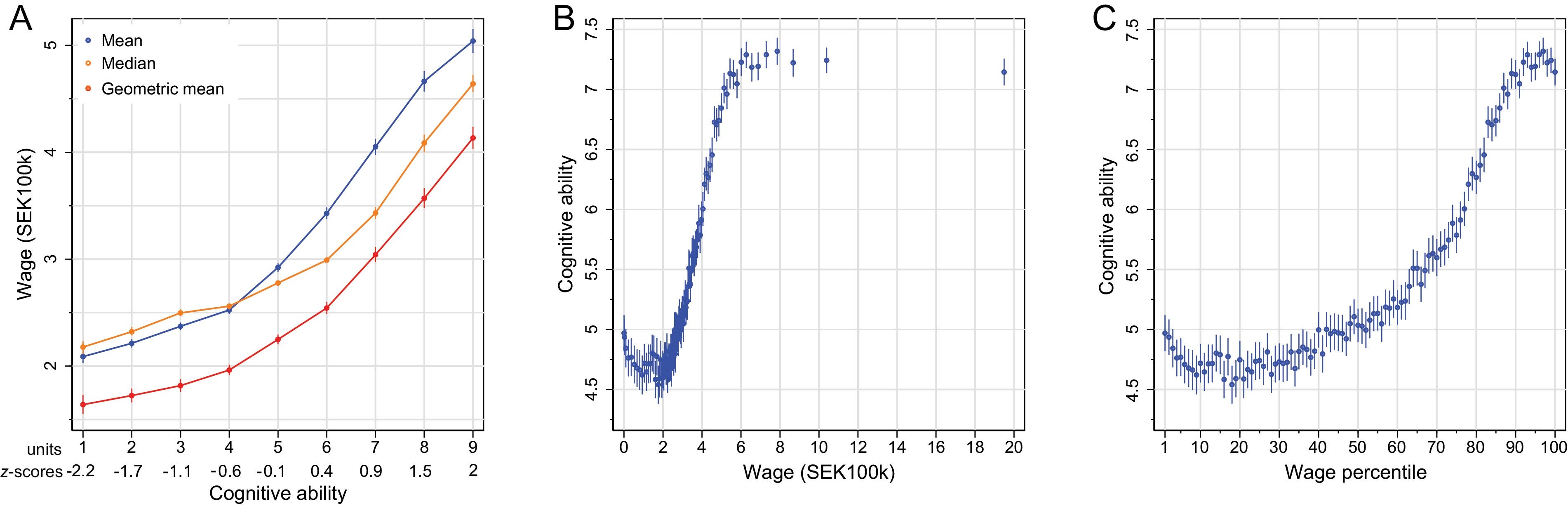
Amongst high earning Swedes, the average IQ stands around 1 standard deviation above average, and this trend continues even for the higher earning groups, indicating a plateau of the relationship between earnings and intelligence.
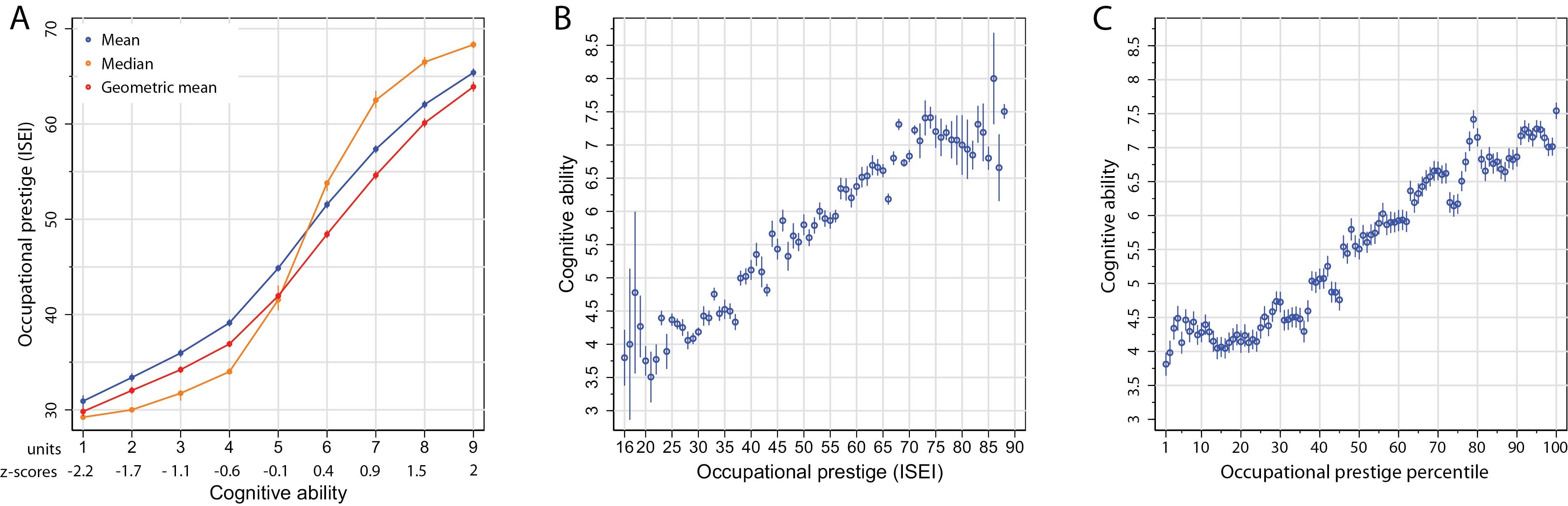
We find a similar relationship for occupational prestige:
Also, sidenote but interesting: for risk of a person experiencing unemployment and low earnings, being a dick (they call it ‘noncognitive ability… based on a personal interview’) is a bigger predictor than low cognitive ability, but cognitive ability becomes the big predictor for one’s chances of gaining above-average earnings.
But anyway. If we took this Sweden result as read, we might think that there are diminishing returns to earnings and prestige from IQ. Once one exceeds that 1 standard deviation, perhaps it makes sense to focus on other traits. But this would be getting a bit ahead of yourself! Notice, these are averages conditional on occupational prestige and earnings, so they tell us the average IQ of people by earnings, not automatically how much IQ affects income.
It could be that higher than 115 IQ does increase one’s chances of very high occupational prestige, and yet the average of people with occupational prestige still average around 115. I think this objection is true, but can be exaggerated: if we expected having an IQ above 115 to have a big positive effect of earnings, then we would also expect the average of high earners to be shifted above 115. So, I think the plateau really does suggest that IQ has diminishing returns on income.
But the story doesn’t end there. There is a paper which, using data from Norway and Finland, finds a different result, identifying that IQ keeps its positive correlation with earnings past a 1 standard deviation above average gain! See the continued growth in the graphs below.
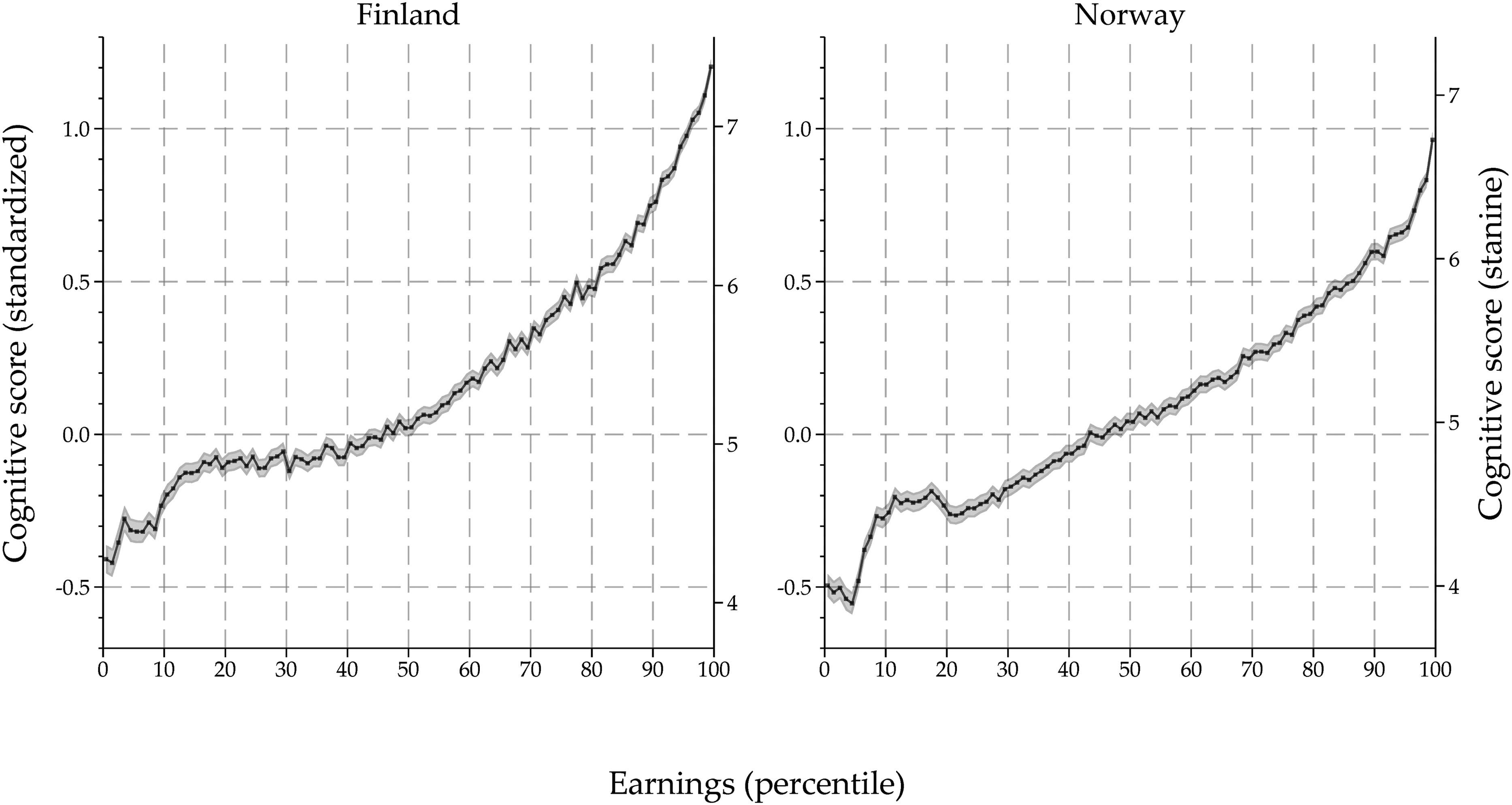
Where Sweden had a plateau, Norway and Finland had continued growth!
This result is difficult to explain away, since these are all reasonably similar countries.
But maybe the importance of IQ for earnings has changed over time? As the world becomes more complicated and more specialised, perhaps the advantages of IQ have changed? Let’s check against the timings of the data used in the papers:
The Sweden paper looked multi-year averages in earnings and prestige percentiles, focusing on men entering the workforce between 1991 and 2003 (so likely mostly men born between 1968 and 1984).
The Norway and Finland paper looked at men born between 1965 and 1972 and assessed their income between ages 35 and 45.
So, the Sweden paper actually looked at men born, on average, after the Norway and Finland paper! But another thing now becomes obvious: different timing after entering the workforce. The Norway and Finland paper looked at men aged 35-45, whilst the Sweden paper looked at multi-year averages.
Let’s break down those multi-year averages:
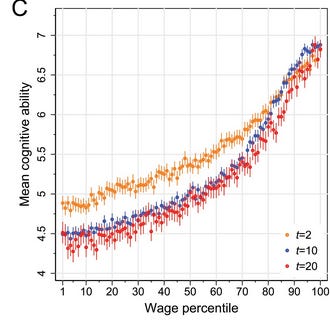
‘t’ denotes the number of years into one’s career. We can see that wage percentile becomes more elastic with respect to cognitive ability as time into one’s career increases.
It’s also not obvious visually if there really is a plateau at t=20 (i.e., 20 years into one’s career), although it looks like there might be at t=2 and t=10. Let’s zoom in! This is what it looks like focusing on the 80th+ percentiles of income:
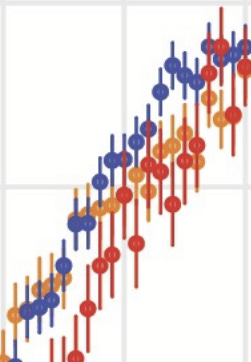
Looking at this, it’s noteworthy that no percentile has an average IQ above one standard deviation above the median.1 That does suggest that the average person earning in the top 1% has an IQ less than 115, which is interesting and does cast doubt on those who think there is a super strong income-IQ relationship.
At the same time, I don’t think there is an obvious plateau at any of the variables, but rather a kink at which they become less steep. Looking at the whole data, t=2 has a kink around the 85th percentile of income, beyond which mean cognitive ability rises more slowly with respect to earnings percentile and t=20 has a kink around the 90th percentile of income, beyond which cognitive ability rises more slowly with earnings percentile. t=10 has the closest to a plateau, with the top 4 percentiles being roughly flat in mean cognitive ability and a slight drop between the 93rd and 95th percentiles.
Does this stuff mean a plateau? I don’t think so. When we look at the separated data, it looks as though mean cognitive ability still continues to rise with income in the 20th year of career. This might also resolve the tension between the papers.
Most Swedish men entering the workforce with high IQ will be doing so around the age of 22 years old. In the 10th year in their career, they’ll be around 32 years old, which is before the 35-45 years old men examined in the Norway and Finland paper.
Therefore, the thesis that IQ higher than 115 isn’t, on average, important for raising earnings past <10 years into one’s career but seems to become useful sometime between 10 and 20 years into one’s career is consistent with the data in both studies.2
TLDR there isn’t a plateau between IQ and income in the long run and having an IQ more than 1 standard deviation above average (top ~16% of the population) is not a necessary condition for reaching the top 1% of income (in fact, over half of people in the top 1% of occupational income have an IQ below 1 standard deviation).
the data shown above runs from earning percentile 80-99 along the x axis, and cognitive ability 6-7 along the y axis, and the median was 5 and the standard deviation 1.98 in the population (although there was significant skew, with a mean of 5.45, so we’re not really dealing with standardised IQ here!).
This might be because of cognitive decline. Even if an IQ of about 1 standard deviation gives sufficient advantage and has diminishing returns after that, it might be that having a higher IQ is still useful because one will remain with an IQ more than 1 standard deviation above the average relative to workers <40 for longer.
I do think about the relevance of IQ for protection now and again. I know someone ~90 years old who took the MENSA exam, obtaining an IQ of something in the 141-144 of the 15 point=1 standard deviation scale (I can’t remember exactly), placing them in roughly the top 2 or 3 in a thousand people. It’s quite obvious that they have lost a lot of cognitive capacity, and yet they are still a perfectly functional and independent 90 year old! I think, had their starting point been average intelligence and they lost the same IQ, they would be struggling to live independently.
You can fight the risks of age to cognition in two ways: slow the decline, and have a head start.
I also want to clarify the reasoning behind me saying that having an IQ above 115 becomes useful deep into one’s career. The data shows a more strictly positive relationship between income and IQ ~20 years into one’s career, even though the average of any percentile never exceeds 115. But a shift in the average IQ of a given percentile of income towards 115 is likely caused by more people in the percentile with IQs north of 115, and fewer with IQ below. It could in theory be caused solely by fewer people with an IQ below 115 and more people with an IQ around 115 (i.e., it remains true that there isn’t much advantage of an IQ north of 115, but having an IQ south of 115 begins to matter more), but it’s more likely that that it’s both a reduction in the proportion with an IQ below 115 and an increase in the proportion above 115.