
DeepLeftAnalysis Is Wrong On Population & Economic Growth

DeepLeftAnalysis🔸 tells us that, if you want economic growth per person, you should want [EDIT: one-off] population decline. He provides a mix of case study and theory to make his case – and yet his analysis fails. I’ll tell you why.
At the core of this is the idea that resources should be spread out amongst fewer workers – and it is true that this is a big deal. In economics, we call it capital dilution. That is why, when the Black Death wiped out millions of people, production per worker went up. Suddenly all the best land and tools and barns were at the disposal of the remaining workers. That’s great if you only care about next year’s harvest. What DeepLeft overlooks is that this doesn’t EDIT meaningfully permanently boost capital per worker give us a model of sustained growth.
Following the Black Death, only Holland initially, and then England, experienced long run economic growth. Most of Europe just oscillated around their new level for hundreds more years – or even declined back towards the income per head they had before. According to DeepLeft, the response to the Black Death should have prompted a renaissance in incomes, not just culture, as resources are concentrated in fewer workers – and yet only Holland emerged from the dust with long run growth.
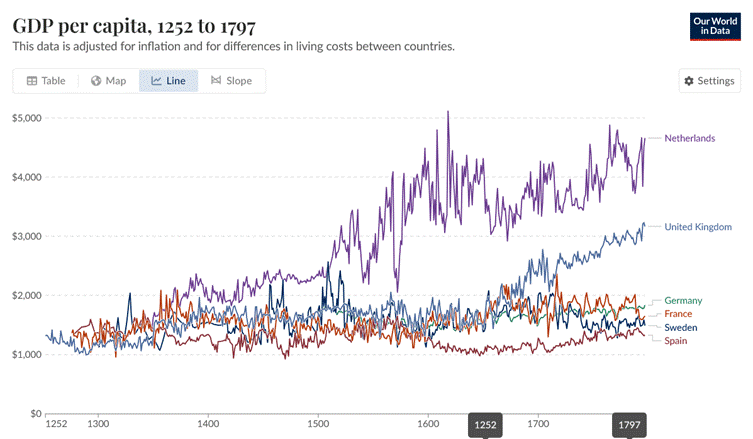
Look at Germany, France, Sweden and Spain all lagging behind the Dutch-English growth juggernaut as late as 1800. None of them experienced any serious growth since 1300, Black Death notwithstanding. Why was Holland such an exception? Because Dutch growth didn’t depend on contracting the population – and indeed the Dutch population recovered from the Black Death at a similar rate to other European countries. Rather, Holland had an economy that incentivised innovation and trade.
Clearly, a cut in population isn’t enough to pull off long run growth. But why not? We already have a model in economics which deals with this – the Solow Model. We have a couple of big factors of production – labour/work and capital, i.e., the stuff that makes work easier, eg machines. The sad thing about capital is that it decays – the fence rots, the axe rusts, the machine malfunctions. We can make more capital – we could even make it the majority of our production. But as we have more capital created, we will also have more capital decaying.
To explain this to my students, I often use a simple model first. Suppose I create 100 units of capital every year, but 10% of what I had last year decays – it rusts, it malfunctions, whatever. First year I have 100. Second year, I make 100 new, but I only have 90 from the year before (100 minus 10% of 100) – so I have 190. Third year, I make 100 new and have 171 from the year before (190 minus 10%) – so 271. The same calculation the year after gives me about 343.
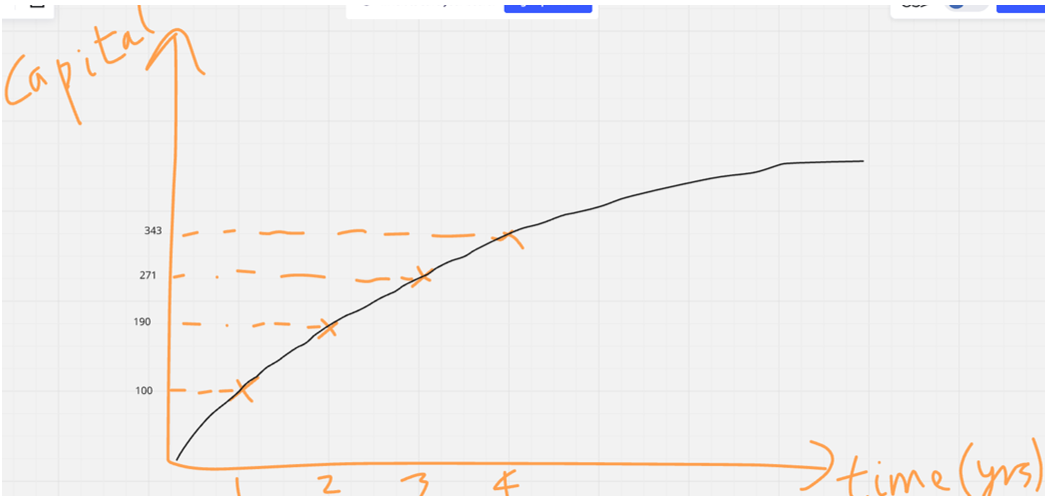
100, 190, 271, 343. My capital growth is getting smaller! From adding 100 units to adding 90 to adding just 81 – and so on. By the time I get to 1000 units of capital, my 100 units I create every year is the same as the 100 units that are decaying every year (10% of 1000) – see graph below. I can’t grow my amount of capital – my capital stock – forever. A better model would take into account that as I make more capital, I produce more[1] – but it still ends up with an eventual limit at which I make the same amount of capital as decays.
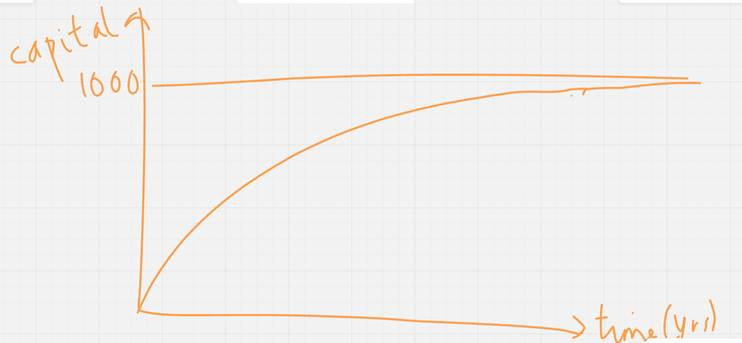
This means that just pulling up the hatches on what capital we already have amongst fewer people is no way to create prosperity – essentially since that extra capital will need replacing by the work of fewer people, which is no fun.
How do we get long run growth then? It comes down to innovation. Finding new ways of producing things allows us to do more with less. In economics we try to capture this in ‘total factor productivity’ (TFP) – driven by enterprise and invention alike. The growth of TFP is hugely dependent on the number of workers we have, for obvious reasons. The more workers, the more people trying out stuff – some of which will work!
It is very difficult to build a model of productivity growth that consistently fits the data, however the optimal rate of population growth for innovation seems to be positive. Clearly, there is a limit – if we do nothing bt make babies, then that will hurt innovation through some opportunity cost. However, the fact that people are useful suggests that moderate positive population growth is the way to go. That is not the path below replacement fertility is leading the global population towards.
What’s more ideas – unlike capital – don’t wear out over time. They can also be shared without diluting their use. If I share my machine with you, I can’t use the machine as much. If I share an idea with you, I still get to make full use of that idea. Economics also has a word for that – ideas are nonrivalrous.
Sure, in the short run having more capital per worker due to sudden spikes in deaths might create more innovation as there’s more stuff to play with. But in the long run, that capital will decay, and you will be left with fewer innovators (i.e., people). Look at (literally) poor Germany after the Black Death (or France, or Sweden, or countless others) – all that death and only a historically insignificant temporary bump in living standards before a resumption of previous peasantry.
Long run growth needs more people – not fewer.
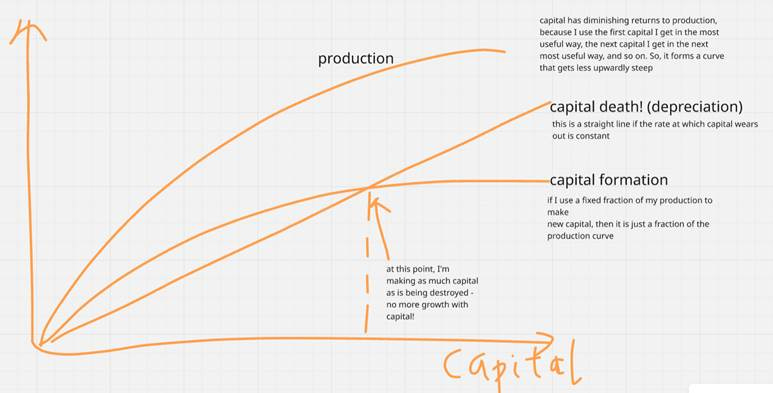
As long as there are diminishing returns on production from capital and there is a constant rate of depreciation of capital, this result will hold - the linear trend will always intercept the trend with a falling upward gradient. I can increase the fraction of my production that goes to capital creation, but there will still be an intercept at which my capital creation is equal to my capital depreciation.
What’s more, all the time I increase the fraction of my production that goes to capital creation, the less of my production I can enjoy on consumption today!
So, there is a tradeoff and we can find the optimal level, but it will not lead to long run growth - there is still that point at which I’m running (in capital creation) to stand still (offset capital depreciation).
Do message if you want full workings on the Solow Model, including ones that factor in TFP growth.
"What DeepLeft overlooks is that this doesn’t give us a model of sustained growth... Clearly, a cut in population isn’t enough to pull off long run growth."
There seems to be no disagreement between us, except that you ascribe beliefs to me that I do not hold.
My original article wasn't saying that reducing the human population to 20 dudes would produce more economic growth than 8 billion people over the next 200 years. My article was showing that over short periods (less than 100 years) you can have economic growth DESPITE a 10% population decline.
I am trying to diffuse hysteria over TEMPORARY population declines, like the ones we see in Europe, Japan, and South Korea. I do not think these will lead to the collapse of civilization, SO LONG AS they can be solved within the next 100 years, which is entirely plausible. It is not a crisis, and calling it a birth rate crisis obscures and distracts from much more important issues.
I am trying to refocus our collective problem-solving capacity away from "more births" toward solving problems of international security via foreign aid. For example, our goal should be to do to Africa what the CCP did in China, in a more humane and peaceful way. That seems to be an easier and quicker problem to solve than trying to get gay zoomers to pump out more babies.
It is my belief that after 2-3 generations of record low birth rates, natalism will win out naturally, without the need for government intervention. I think Ryan Burge's data on religion shows this quite clearly: there are diminishing returns to the secular erosion of religion. What you are left with is a kind of "antibiotic resistant strain" of religion which can survive the ideological pressures of modernity. No need for child tax credits, housing subsidies, or any of the other extremely expensive $200k-per-baby schemes.
With that having been said, I'd like to add on some things which move beyond the scope of your article, and push this conversation into the realm of a more substantive debate which will be more useful to both of us as well as my audience.
Depending on your view of the heritability of IQ and the cultural cost of diversity, immigration has already solved the problem of low fertility. We don't have a declining population at a global scale, and I don't often see models that predict global shrinkage before 2100. So we have 75 years, which is quite long enough for the problem to be solved without the kind of authoritarian theocracy or fiscal irresponsibility (expansion of welfarism) advocated by natalists.
One of the natalist objections to immigration is that they believe immigrants have low economic productivity because they have lower genetic IQ than white natives. Some natalists hint at this view without being honest enough to say it and claim to be anti-racist. Whether or not it is racist, it deserves to be addressed in a rational way.
When we get into IQ, I would make the argument that it is much more important for economic growth within a welfare system to reduce the population of people with an IQ under 70 than to increase the population of people with an IQ of 100. I would argue that poor people are more sensitive to natalist monetary incentives, and therefore, these incentives are inherently suspect from a long-term economic point of view, taking into account the financial burden of low intelligence.
You have claimed that by using extremely complex and targeted policies, you can ameliorate this risk, but I think that government policies can never be this precise and they always degrade toward the lowest-common-denominator. If you want to build a bridge in a year for $100 million, it gets built in 10 years for $1 billion. Similarly, if you want eugenic natalism, you're going to get dysgenic natalism. This isn't an attack on your position specifically, but it is an attack on your faith in the precision of government as a tool for changing human behavior without generating negative externalities.
To conclude: While I appreciate your dedication in trying to refute my views, the views you have refuted are not the ones I hold. If you read my original article and got the impression that I was saying, "we only need 200 dudes for the next 300 years, and we will have more economic growth than a billion dudes over 300 years," that is either a mistake of interpretation on your part, or a lack of clarity on my part. I hope my response here clarifies my view and we can move forward and get into real disagreements, as pertain to pollution, security, immigration, and human intelligence. -DLA
One might have a model in which a low level (Malthusian) equilibrium trap is broken by an exogenous population decline and some of the increase real income per person goes toward creating innovation (or just any kind of by-hypothesis non-depreciating capital?).