
Darwin and The Knowlton Trial

A 19th century PR stunt immediately preceded a pattern of delaying family life.
The PR stunt (explained below) changed norms around contraception1 and immediately coincided with people delaying their age of marriage. The cultural movement towards de-prioritising commencement of family life therefore didn’t begin in the 1960s (sorry, Second Demographic Transition enjoyers), but had its roots much earlier with the reimagining of society by some secularists. But the most prominent secular thinker of the time, Darwin, thought this was a terrible thing! There is scope for a family-centred view of life shared by both the religious and the secular, but this 19th century PR stunt has led many to think otherwise and still reverberates in our family-formation decisions today.
In 1877, a trial occurred in Britain on the censorship of the publication of a pamphlet spreading methods of birth control, known then as the artificial limitation of the family. Whilst the methods described were ineffective, it prompted a storm of debate about the ethics of contraception across classes in society. Ideas which had been limited to well-educated radicals since they first emerged in the 1820s began to permeate,2 and the news of this trial was the spark of the mainstreaming of the use of ‘artificial limitation of the family’ across the Anglosphere and beyond. Prior to that, only French-speaking Europe had undergone a mainstream acceptance of this practice.
As Darwin was the great man of the theory of evolution and thus stood in contrast with what was at the time conventional religious teaching on Creation, one of the two on trial for the publication of the pamphlet, Bradlaugh, assumed that Darwin would support this radical departure from conventional religious teaching (back then, all mainstream churches deemed contraception immoral). So, he had someone asked Darwin to speak as a witness in his defence. Darwin pled ill health, responding:
Though I heartily agree with you and with them that the principle of population, as laid down by Malthus, is true, yet I cannot look at the question as one of science alone.
I should be sorry to express any opinion publicly on the subject of birth control, and I cannot persuade myself that it is wise to attempt to check the rate of increase by artificial means.
Later that year, in correspondence with a friend, Darwin was more emphatic:
I have read the trial, and I am very sorry for them. I cannot think that anyone would be the worse for reading the book; but I do not like the idea of the means recommended.
It seems to me that their use would lead to much immorality; and I do not see how such means could be used without weakening the feeling of self-restraint, and without rendering marriage less sacred.
In 1849, at 40 years old, Darwin had stopped attending church, and he later said that it was at this time that he left his Christian belief. Yet his moral sensibilities did not correspondingly lunge to those of the radicals. The Darwin Correspondence Project goes further in its summary of his views as expressed in his letters, observing:
[Darwin] would prefer not to be a witness in court. In any case CD’s opinion is strongly opposed to that [of Bradlaugh and Besant]. [Darwin] believes artificial checks to the natural rate of human increase are very undesirable and that the use of artificial means to prevent conception would soon destroy chastity and, ultimately, the family.
It seems that Darwin still maintained moral sensibilities of his time, but rooted them in secular sources. He believed in loving one’s family and devoting oneself to the productive endeavours of his family, his work and his community.3 Despite being severed from a religious justification for these sensibilities, he held them to be true.
There is another example of this type of concern. Francis William Newman was the younger brother of John Henry Newman, the famous Anglo Catholic who converted to Roman Catholicism, became a cardinal and was canonised in 2019. They both grew up as evangelical Anglicans, and both found it lacking. But where John sought certainty in apostolic succession, Francis became increasingly doctrinally liberal. By the time of the 1877 trial, Francis Newman remained a theist, but was agnostic on most matters of Christian doctrine.
Later, Francis Newman wrote The Corruption Now Called Neo-Malthusianism. In this pamphlet,4 he tore into the view that increases in the population posed a threat to living standards and an increase in poverty. He went on to point to the role of Malthusian views in motivating the efforts of the likes of Bradlaugh to respond with liberalising attitudes to limitation of the family.
Newman, also writing entirely from a foundation void of orthodox religion, felt this was misguided. He argued that a large amount of poverty can be attributed to vice and social problems, not the mere size of population. He then laid out how he thought the neo-Malthusian view would exacerbate these problems. He worried that an expansion in birth control would result in an increase in men’s demands of women’s sexual access (an argument Louise Perry and others make today) and would lead to more behaviour focusing on achieving short term pleasures over long run fulfillment.
Newman observed that many of the radicals were focused on ensuring that personal whims could be expressed, but possessed far less focus on how people built productive relations designed for the long haul. Francis Newman struck a Petersonian figure who, cut off from a belief in the literal truth of Christianity, looked to ideas from religious tradition and combined them with the intellectual innovations of the time to make some effort to build up an ideal of human interaction oriented towards human thriving. For Newman, the new preoccupation with the limitation of the family would give way to the indulgence of vice over consideration of consequences and building relationships conducive to the good, whilst both Newman and Darwin expressed worries that a change in thinking patterns about control of family size would eventually lead to a de-prioritisation of family life that would be, in the long run, to the detriment of people’s quality of life.
So, were they right? On the conventional view of history, their fears did not materialise: family size fell immediately following the trial, but pretty much everyone still formed stable families at some point.5 On this view, significant changes in norms about family formation only came nearly one hundred years later, beginning in the 1960s.
This view of history is wrong.
The median age of first marriage for men in England and Wales began to rise immediately following the trial, suggesting that family formation started to be delayed immediately after the trial. The Knowlton Trial precipitated what was plausibly the beginning of the move from a ‘cornerstone’ model of family (in which family life is seen as the… cornerstone of a fulfilled adult life) to a ‘capstone’ model (in which people delay family after filling early adulthood with other activities.
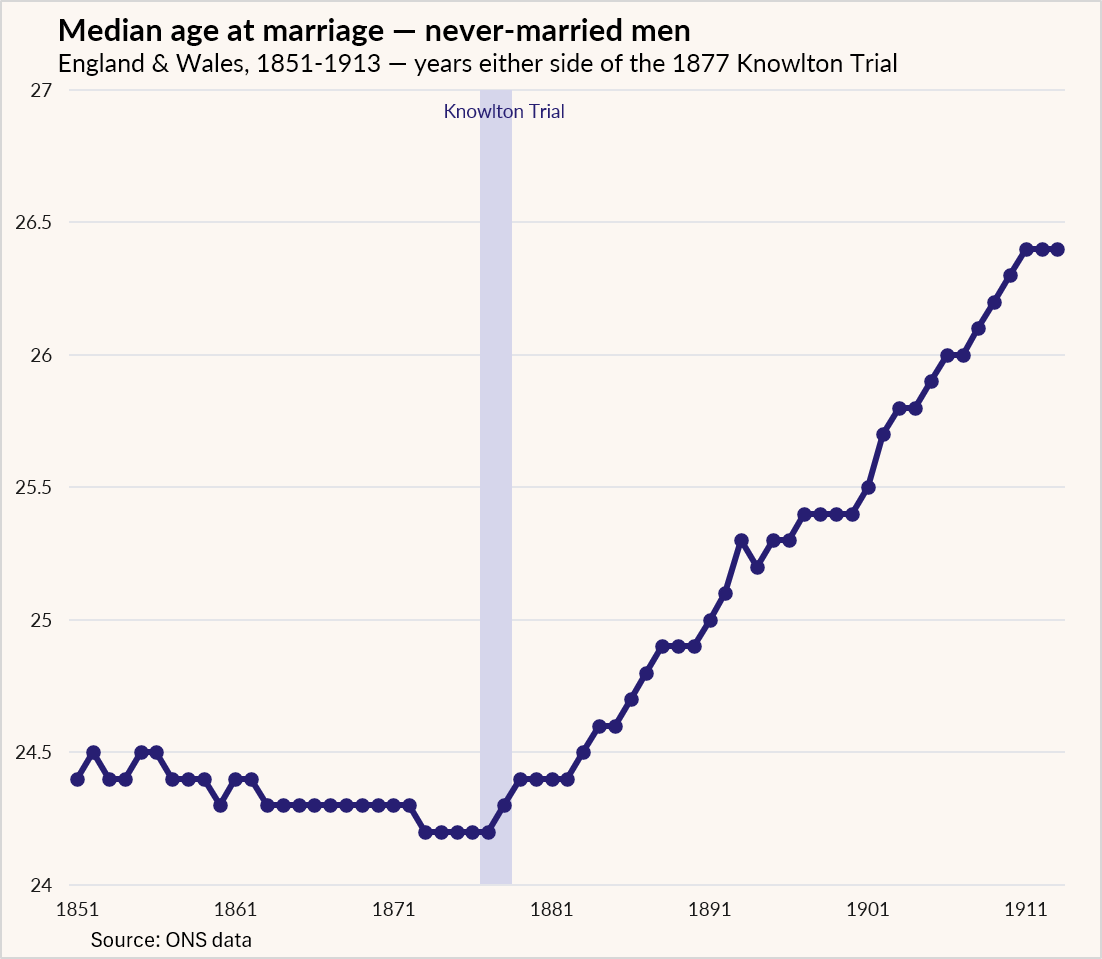
I mentioned this to Lyman Stone, who then ran comparisons to other countries. The news of the Knowlton Trial spread across the English speaking world rapidly, so checking trends in Massachusetts and England & Wales against those of France and Sweden (to pick a couple of European countries with old marriage data) gives tells us whether the change in marriage age trends is localised to places exposed to this culture shock. We see exactly what we would expect if the trial did precipitate a new trend in age of entering into marriage.6 The French and Swedish mean male age of entering first marriage even slightly decreased after the trial occurred in Britain, giving us little reason to suppose that the British marriage age would have increased anyway! Meanwhile, British men’s age of first marriage rose steadily until World War 1.7
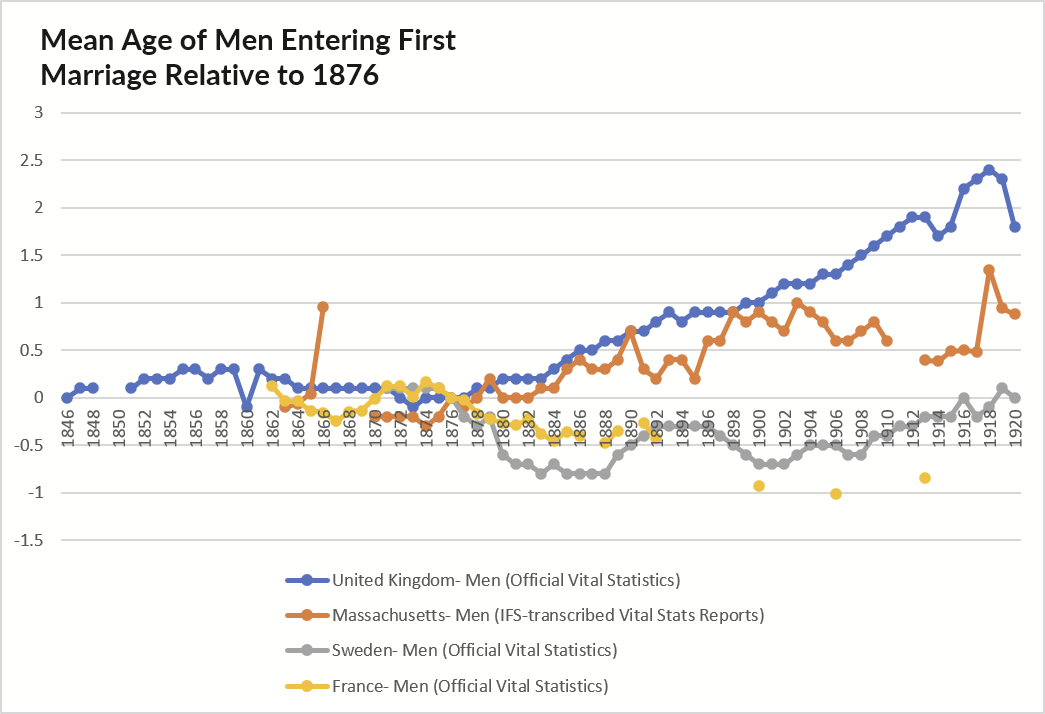
When Bradlaugh and Besant circulated a contentious pamphlet in front of police—some might say in order to deliberately induce a legal controversy—the spread of debate about ‘the artificial limitation of the family’ resulted in reduced family size… but Stone and I have also shown that it immediately preceded a delay of family formation in Anglosphere locales for which we had data to hand.
Darwin, Newman and similar commentators of the time may have been far more prescient on this issue than we’ve given them credit. And it raises the question of whether the time has come to take another look at how we prioritise commencement of family… instead of being buffeted by how a paradigm change potentially beginning 150 years ago interacts with technological/economic/social conditions of the day.
PS This article provided interesting background: https://warwick.ac.uk/fac/cross_fac/iatl/study/iatlugmodules/censorship/teachingandreadingmaterials/schwartz_infidel_feminism_2013.pdf
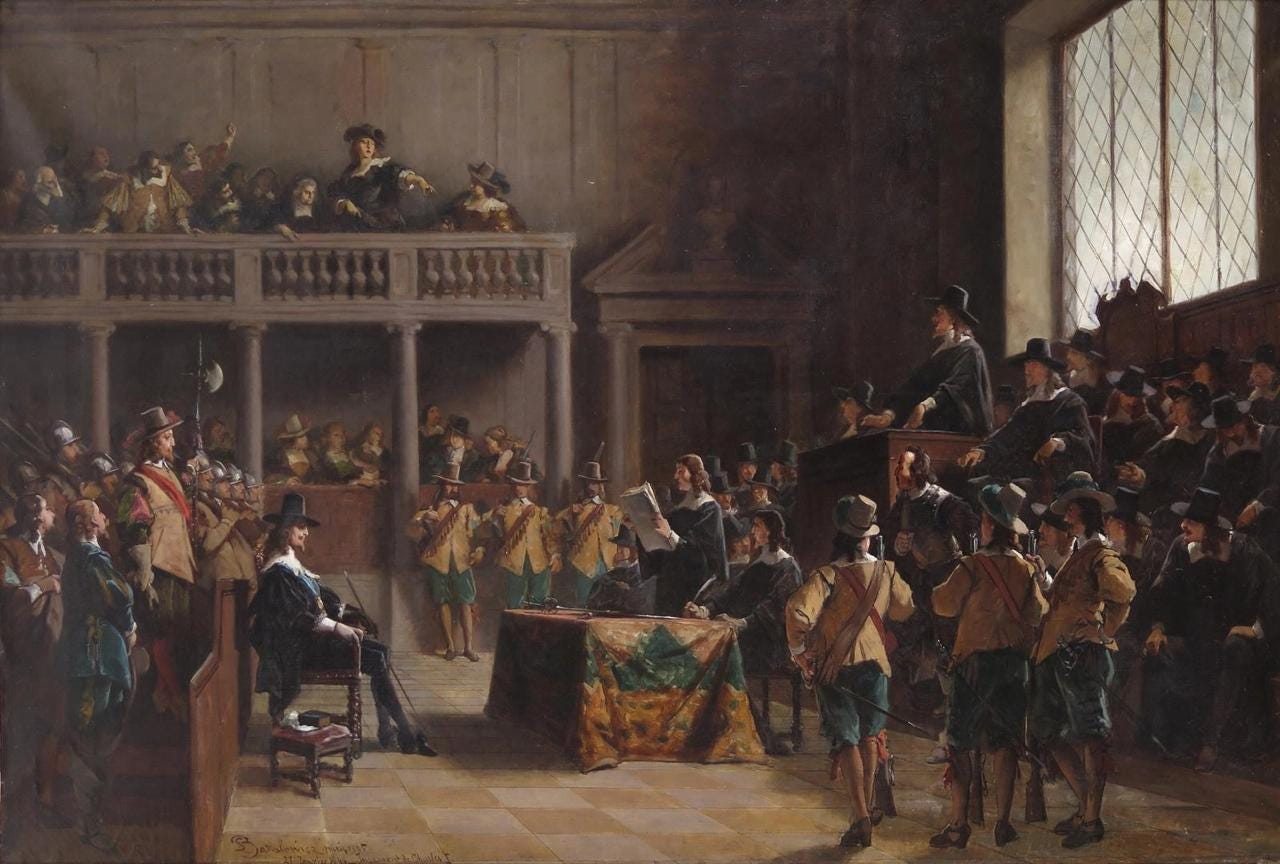
The Trial of Charles I (1856) by Charles Lucy
In the Anglosphere
Malthus published An Essay on the Principle of Population in 1798, but his concerns about overpopulation were limited to the alleged effects on famine and prosperity, and his solution was postponed marriage and chastity outside of marriage. In his answer to his model of population, he was very in keeping with the traditional Western European Marriage Pattern, in which children were almost entirely born within marriage and all sons move out and establish their own household when they marry, meaning that marriage (and in turn fertility) is responsive to economic conditions.
What Malthus motivated directly, however, was fear of rising population, and a willingness from others to think more broadly about how this could be answered. When free thinking radicals combined their scepticism of traditional religion with a Malthusian fear of population growth, the idea of pushing contraception and pushing the idea that contraception would enable ‘free love’ without the ‘burden’ of children grew.
By all accounts, Darwin and his wife were pillars of the community, even running a games club for local men so that the men could relax in prosocial (or at least not antisocial) ways.
As best I can tell from piecing together different references to it—I couldn’t find any record of a digitalised version of it.
The linked paper does note that the marriage rate fell by 2% in places likely most exposed to news of the trial after the trial (which could be entirely a tempo effect, they don’t investigate), but they estimate that it would account for at most 30-40% of the effect of the trial on fertility, so the trial did affect fertility within marriages/family size.
Women’s age of marriage began to pick up in the UK several years after, suggesting that men began to delay marriage and average age gaps increased for a few years before delayed marriage began to occur amongst women. Being speculative, I think this suggests that changes in men’s behaviour drove the change here—perhaps the growth of debate and acceptability around contraception really did reduce the close coupling of sexual access and marriage, in turn increasing the proportion of men happy to delay marriage.
Which was of course in fact the true second world war, following the success of the British in the Seven Years War over the French and the Spanish. You are welcome, world.