
Current Monetary Regulation Is Anti-Family—Here's How We Fix It

Ten days ago, Johann Kurtz released an article titled “Young adults are poor despite every metric which suggests otherwise”. The graph below sums up his argument. It shows that the things which comprise the costs of a meaningful life (care, education, housing, raising children) have outpaced the average level of inflation, offset by luxuries like televisions (for example) becoming cheaper.
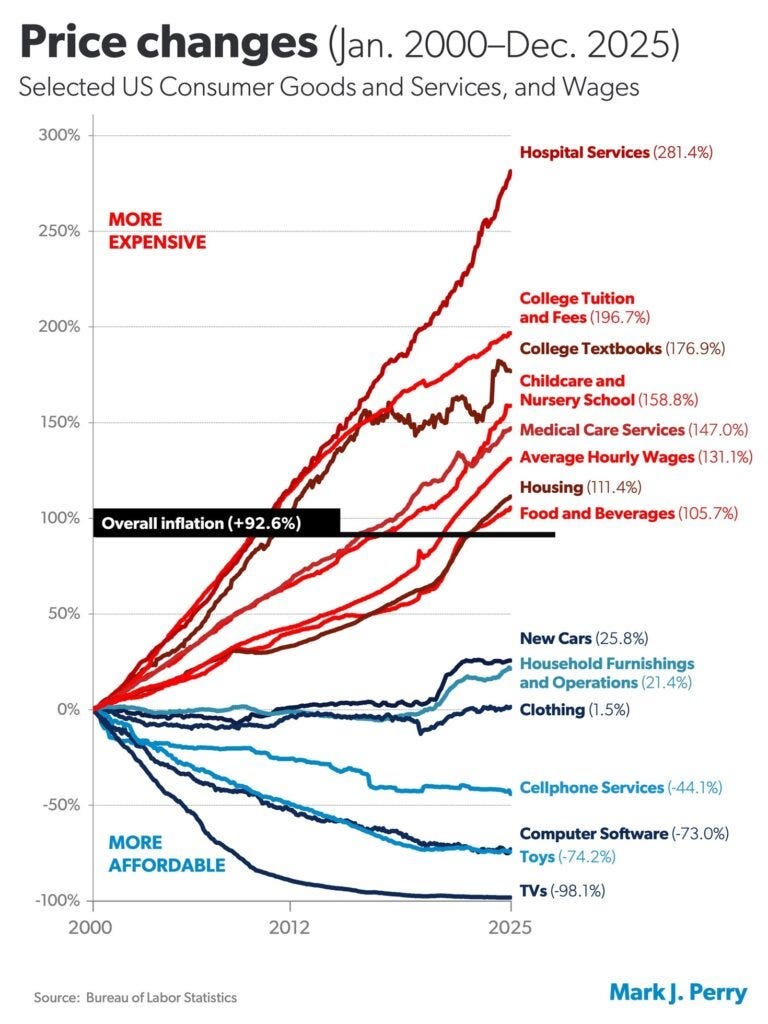
Some have claimed that the variation in the increase in prices is due to Baumol’s cost disease (whereby wage increases drive increasing costs of labour-intensive goods and services like childcare), an explanation popularised by Alex Mayyasi writing for Derek Thompson in this piece. Some have said that the variation is due to regulation (notice that more regulated industries tended to have faster price rises). I think both are somewhat true, although there’s also a third factor: new things tend to have faster rates of innovation (because they’re… new, i.e., many efficient ways of doing them are yet to be discovered).
I think that the Baumol explanation and my new-products explanation give us a problem. As Thompson elucidated, many of the things that are pretty crucial to our thriving (such as care work) are, by their nature, labour-intensive. And most of the things which are essential to or very useful for living meaningful lives (shelter, receipt of care (medical and nonmedical), education, etc) are pretty old—and therefore enjoy lower rates of innovation and, correspondingly, price growth at the higher end.
But why would these things be increasing in price from a lack of innovation? Surely we should expect them just to stay the same. If only it were so! Because there is crazy innovation in tech and other new shiny things, the prices of new products would be falling pretty dramatically, all else held equal. This would cause deflation, and for central bankers deflation is the monster under the bed. Deflation, left unchecked, leads to economic decline.
To prevent deflation, central bankers use monetary policy (interest rates, quantitative easing, quantitative tightening) to regulate average prices (the price level). So, if the price of the smartphone and the television are falling like mad, the central bank will respond by boosting the average price level. In short, the price of everything else will be pushed up by the central bank, to offset the price decrease of the shiny new things.
I think, when it’s laid out like that, everyone can see a problem. On that trajectory, the prices of the things that are most important for meaning in life will outpace average price increases and likely outpace earnings growth. We have become poorer in meaning-rich things, and are likely to keep getting poorer.1 Unrealised goals in this department will lead to a continued increasing sense of meaninglessness and rates of depression (and those links are to causal research on the effects of having or not having wanted children, I’m not just handwaving to general trends).
I think we can also see that, if Baumol’s cost disease and disparities in innovation and meaning-making stuff are a big part of the issue, then deregulation might help, but will only take us so far.
So What Is To Be Done?
You might be thinking “there’s a simple solution to this, let’s get rid of these crazy central bankers and their inflationary pressures”. And the central bankers might well be crazy, but they’re not imagining things when they say that deflation is a monster. In the 19th century, we did not have the ability to easily regulate the price level. When economic downturns happened, deflation happened, and the economic downturns got deeper. It is good and right that we have monetary policy.
The problem is that an unbiased monetary policy leads, inadvertently, to a depression in our ability to secure meaning-rich things.
I am here to advocate bias. If we care about a model of prosperity that encompasses people living meaningful lives, rather than having infinite access to AI chatbot compliments and shortform content of teenagers dancing, we need to solve this problem.
But how do we add this kind of ‘bias’ into the economy? There are a few different ways bias could be introduced. When a central bank loosens its monetary policy to push up inflation, it (one way or another) floods money into the economy. Before getting into the details of how we can direct the money (because this is a thorny issue, and I am well aware of the risks of this being done badly with terrible consequences), I’ll first just lay out a couple of options of how we could seek to ensure that price increases aren’t disproportionate for meaning-rich things:
Subsidise the good life stuff
Reallocate incentives towards the good life stuff through other means
The first option might involve, for example, subsidising childcare, or subsidising housing. I believe it is a risky option for two big reasons. For one, it involves governments directly picking winners and losers. Governments are, more often than not, pretty bad at doing this! In short, it can result in a big misallocation of resources which doesn’t end up helping people that much. But the biggest drawback is that targeted subsidies by necessity involve an increase in the regulatory burden which is part of the problem. Let’s take childcare (this is, if you haven’t guessed, my favourite example). If I want to subsidise childcare (and I want to make sure that my subsidy is going only to childcare), I need to create a monitoring system which decides exactly what counts or doesn’t count as childcare before I decide to give a subsidy. In other words, I need to invent de facto childcare regulations.
Instead of creating targeted subsidies, we could make sure that the incentives (i.e., the expense involved) are adjusted with the usual tools (taxes and/or benefits) to make sure that the meaning-rich things perform well. So, continuing with childcare: who needs to be looked after? Children? What does it cost? Some combination of money and time (so, again, money). Who manages the care of children? Parents. Great, let’s give a tax cut or a benefit to parents. Problem solved.
What about housing? Cut taxes on construction firms, watch competition for construction increase and construction costs go down. What about food? Cut taxes on the inputs (like fertiliser) and watch that do well too.2
What Are The Details of How Central Bank Policy Translates To An Economic Pro-Meaning Bias?
I would not want unelected and bureaucratic central banks to begin directly funding tax cuts, benefits and subsidies. That would be the central bank trying to become a government! I also would not want governments to tell central banks to loosen their policy to fund specific tax cuts, benefits and subsidies (e.g., through demands for QE-purchases of government bonds). That would likely result in insane inflationary pressure very quickly!
But we don’t need to take these radical and dangerous measures to introduce a bit of pro-meaning bias in the economy (to counter the de facto anti-meaning bias in how things are naturally playing out). We just need the right fiscal rule.
When central banks loosen their monetary policy to fight deflationary pressure, governments find it easier to introduce tax cuts/ benefits/ subsidies. Lower interest rates reduce government bond yields, making existing government debt cheaper to finance and new government debt cheaper to acquire. Quantitative easing very directly reduces government bond yields. Indeed, changing the incentives around government spending is one of the ways that loose monetary policy floods money into the economy. A fiscal rule which locked in loosening monetary policy into specific pre-decided policies targeted at improving meaning-making fiscal support would be perfectly in keeping with an independent central bank regulating the price level.3 For the long termists out there, such fiscal loosening could also be focused on supply side measures, e.g., cuts on corporation tax for the construction industry, which would bring lower prices for meaning-rich goods and services for years to come through a measure which brings a transitory inflationary pressure when it is most needed.4
Likewise, when central banks stop applying inflationary pressure, it becomes difficult for governments to sustain spending. So, such spending could be automatically cut back during times of tighter fiscal policy (during which point there is a lack of inflationary bias against the stuff of meaning and therefore less need to offset the bias).
In short, economic growth combined with monetary policy to ensure positive inflation has often made the stuff of meaning-making grow at a faster rate than earnings. During times of economic growth, a meaning-first fiscal rule response to loose monetary policy can go some way towards offsetting this.
There’s also an additional willpower and consumer information point to be made here. As relatively meaningless things become cheaper, it takes more willpower to focus on building the meaningful things. And if people aren’t aware what builds meaning, then they will (completely reasonably under their information and the pricing discrepancies) consume far too much of the things low in meaning-making.
I’m going to ignore healthcare deliberately because Americans need to sort out their market for lemons structure and Britons need to sort out our bureaucracy on that front, so I think that’s its own kettle of fish.
I’m also going to ignore university costs because that is of little interest to Brits!
Central banks routinely estimate the ‘neutral’ interest rate, so a fiscal rule could decide how much spending to allocate in line with the extent of the deviation from the neutral interest rate. Making fiscal policy automatically responsive to monetary policy in part would also increase the efficacy of a unit change in monetary policy, making zero lower bound problems less likely.
This would entail the kind of regulation-by-necessity issue I highlight earlier in the piece, but I think ‘construction sector’ is much more clearly and easily demarcated than childcare.
Though I realize it was just a pluggin to introduce your own thesis,
I think you missed the gist of Johann Kurtz's argument. His argument is that some benefits weren't measured, and those were lost - So even though the numbers look good, they don't tell the whole story.
Think about it like this - You have a Grandma living close by. She watches after the kids, cooks delicious food and comfort you in times of need.
Then, as those things go, she passes away. Your life got more expensive - You need a babysitter, go out to restaurant and now need a shrink. So even if you got a raise at work, and on paper it looks you are doing better economically than last year - in fact you are doing worse, because you lost non-market services, which you now have to buy in market prices.