
Childcare Regulations & Austerity Caused British Fertility To Fall

Childcare regulations of the Blair administration and the austerity programme of the Cameron administration both caused fertility to fall. This explains why the UK stands out amongst developed countries for having experienced falling family size as well as rising childlessness.
To be clear, this is not a party political post. I am merely making two empirical claims in this post: childcare regulations and austerity caused fertility to fall.
For background: the UK was hit particularly hard by the financial crash, and the sudden fall in economic activity automatically decreased government revenue and increased government spending (as more people suffered unemployment, welfare claims increased). This resulted in a suddenly large government deficit, creating worries of the possibility of a sovereign debt crisis in some quarters. In response, the government of the day began making cuts. This was normal across many countries at the time.
However, the next administration (Cameron’s) insisted that the most important metric for prosperity was the national deficit. And therefore, it continued to pursue government spending cuts even as many other countries relaxed their fiscal policy. These cuts included deep ones to public services and public investment. So, did it affect fertility?
Firstly, let’s look at the trends of births by birth order in England and Wales (I’m using total births given a scarcity of fertility rates by parity data):
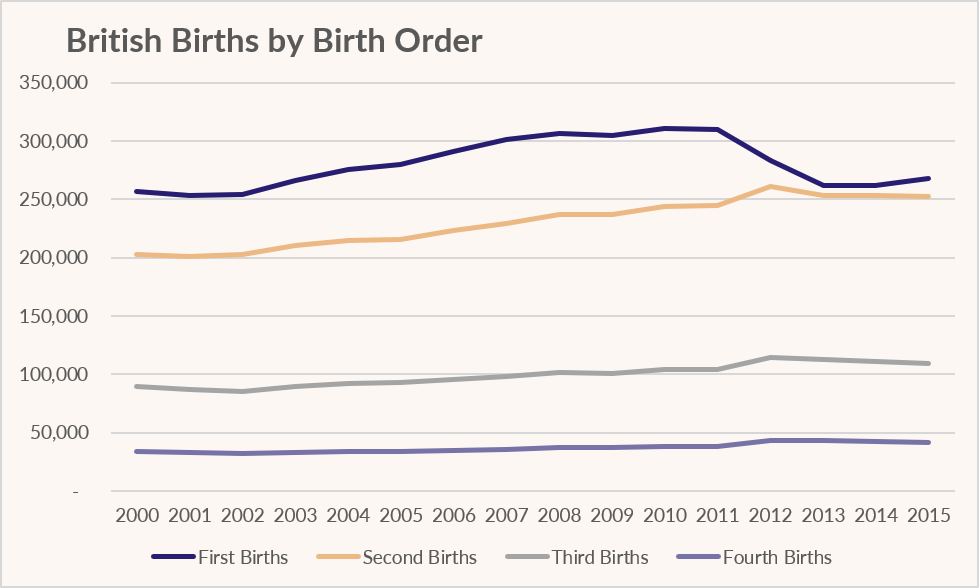
One thing jumps out: there was no big decline in 2009, 2010 or 2011 (in fact, there was a slight increase).
But we do start getting a large decrease in first births in 2012, repeated again in 2013. What could be behind this?
It might not be austerity, even though the timing checks out, because many European countries actually began to have falling fertility in the early 2010s, often around the time that 4G rollout improved across the world.
But the UK began 4G rollout October 30th 2012, making it too late to affect 2012 fertility and probably too late to meaningfully impact 2013 fertility. Yet we see a marked decline in movement into parenthood beginning in 2012. But I don’t want to prematurely rule out an explanation for fertility decline beginning in the UK prior to 4G rollout, so here we see what mobile broadband subscriptions were doing (using ITU data). This is what it looks like for all the years with available data:
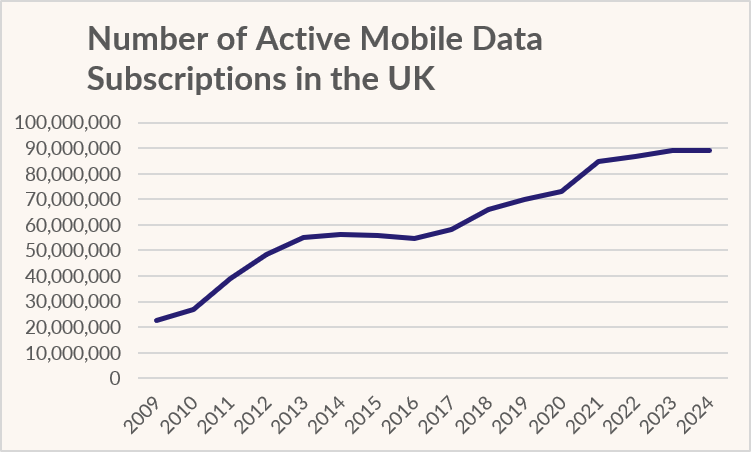
Mobile data subscriptions started rising sharply in 2011, and so might explain the beginning of the fall in first births in 2012. In my working paper, which deals with the effect of mobile data coverage and digital services on fertility and coupling behaviour, I found that panel models which used mobile data subscriptions per capita as the control for technology adoption consistently performed better on the ‘information criteria’ used to assess the best models than those which used 4G coverage as the technology adoption control variable.
So, this might go a good chunk of the way to explaining the decline of first births in the UK, as it likely does in many countries.1 But let’s check if anything else might be going on, by extending out the years of births:
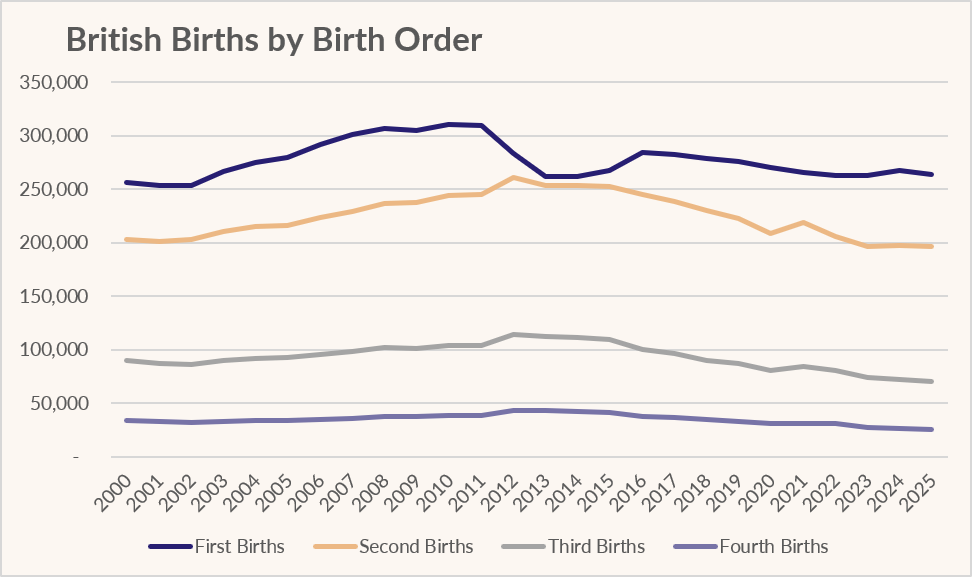
England and Wales is quite unusual in having experienced a sharp drop in first births, a bit of a recovery and then a gradual decline. Most countries seeing downward trends beginning in the early 2010s show a more sustained downward trend, so this gives a bit of a hint that something else might have happened. We also see declines in second and third births beginning in 2013.
That’s odd: in most of the developed world, the fall in fertility in the past ~15 years can be accounted for by declines in people becoming parents at all. In the UK, we see a decline in second and third births too.
Of course, second and third births decline in a world where fewer people become parents (since fewer parents also means fewer people having second and third kids)… but they decline at a lag of ~3 years (average birth interval in the UK). Here, we see second and third births begin to decline just one year after first births began to decline. There is just no way that a decline in first births in 2012 mechanically caused fewer new-ish parents to have third births in 2013!
So, it looks like something else might be happening in the UK than what we’ve seen in most of the developed world lately. Fertility rates by birth order aren’t available for most years, but they were released for 2013-2022. As mentioned above, a fall in first births will naturally result in fewer later order births… but did UK fertility rates for later birth orders fall by more than we would expect just from the fall in first births?
A quick and dirty approach I took was to divide fertility rate for birth order ‘n’ by the fertility rate for birth order ‘n-1’ three years previously, to give a quick (and very very rough) estimate of the rate of people who already have ‘n-1’ children choosing to have an nth child. I show these very rough estimates in the graph below, which shows the steepest decline amongst transition to having a second child!
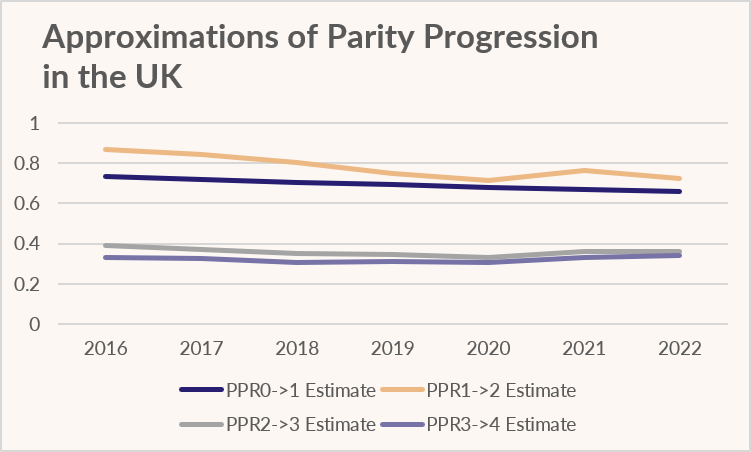
This is pretty wild: the UK increasingly has rates of people stopping at one (the estimate for PPR1→2 fell 16% between 2016 and 2022). We can also see smaller declines in estimated rates at which people have a 3rd (-9%).
Don’t misunderstand me: the UK also saw declining rates of TFR1, the fertility rate of first children born, implying that the rate of childlessness is also on the rise. But family size is also facing a problem in the UK! This isn’t the same problem the rest of the developed world is facing, so saying ‘it’s the phones’ doesn’t cut it in this case (although ‘it’s the phones’ may be a pretty good explanation of the fall in British TFR1 by 10% just between 2016 and 2022).
So, what kind of contenders do we have? Housing costs have been particularly crazy in the UK, which might also be causing a decline in family size. But I’m not sure that it explains why the UK seems to have taken such a downturn in family size in the past decade—our housing market has been getting gradually more constrained since a 1980s administration massively cut social housing construction without introducing an equivalent planning liberalisation to let the private sector pick up the slack. I’d also like to be careful here: yes, I do think that housing matters and that British fertility would be higher if we had more housing, particularly family-friendly housing. I’m just saying that I don’t think it explains the particularly sharp downturn in British family size in the past ~15 years.
What else could be going on? The childcare market has also been getting pretty crazy in the UK. Take a look at this Department of Education graph:
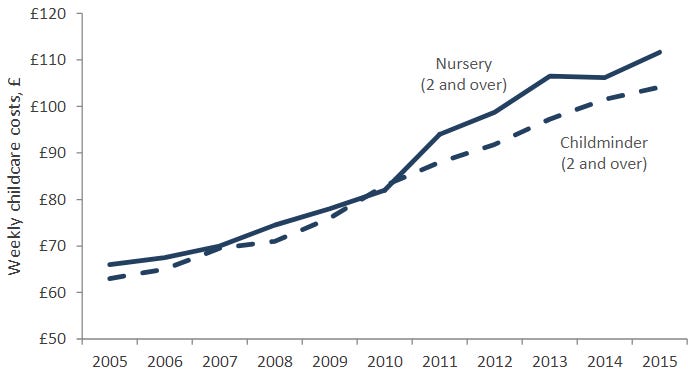
Childcare costs have been rising for some time, but there was an acceleration in nursery costs in the 2010s. And this wasn’t just a product of inflation or rising wages, as displayed in this Institute of Fiscal Studies graph below, which shows that childcare costs have been rising at a far higher rate than both inflation and earnings growth.
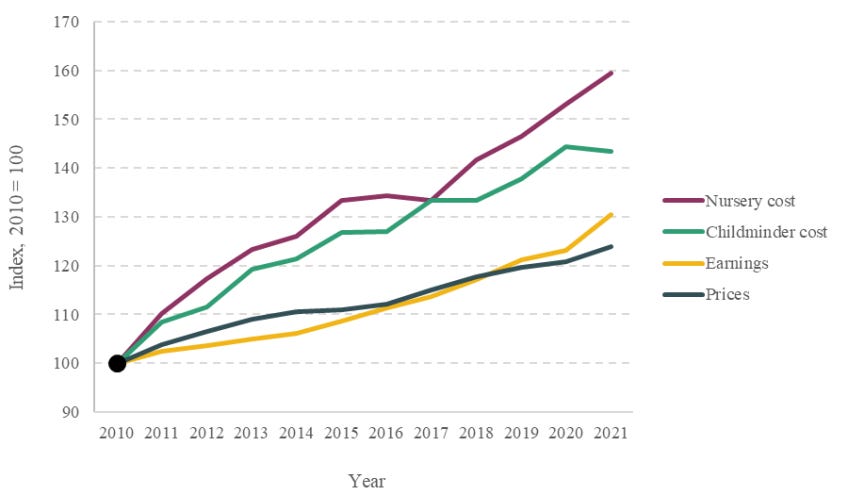
The UK now has the most expensive childcare in the OECD. It didn’t used to be this way, but childcare prices began rising in noughties following new regulations, and continued to rise in the 2010s as new administrations largely left the noughties regulatory framework in place. I think this is probably having an effect! Pair this with the fact that you have to go through expensive regulated childcare to receive any government financial support on childcare, and you have a problem!
There is also evidence for this. When an Italian province reformed childcare to increase both affordability and choice, the fertility rate of 3rd births went up and stayed up relative to a synthetic control, according to research by Marcos Fraser Cabrera and yours truly. It would figure that a change in childcare regulation which made it more expensive and restricted choice
So, I do think that the sharp decline in family size in the UK is in part a childcare problem. Allowing people to claim childcare subsidies in cash that they can use for informal childcare arrangements (such as grandparents!) would be really helpful. Saying that some noughties childcare regulations were well-intentioned but have turned out to have pretty detrimental effects and that time’s up for them… well, I think this would help too.
But is it the only problem? We also know that the UK had austerity beginning in the early 2010s! This meant that low income families had pretty substantial cuts in their real disposable income. The real earnings cuts to these groups have been documented by the House of Commons Library and the Institute of Fiscal Studies, and we know that income shocks come with fertility implications (more income, more babies).
This meant that families with higher earnings, who typically work more hours and therefore rely on childcare (whether informal or family), were pinched by the childcare situation, whilst lower income families were pinched by austerity.
Lo and behold, family size began to fall.
Notes on Limitations
The above is not a rigorous causal analysis. I am relying on reasonable inference. Keep that in mind!
What Does This Mean Going Forward
If I am correct that childcare regulation and austerity (and the housing shortage to a lesser extent) have lowered family size in the UK, this is something we should urgently seek to reverse. It suggests that plenty of people are having smaller families than they would like, fewer wanted lives are being born than we could have, and (in the long run) our economy will also suffer for it.
But these are fixable things!
We can get rid of a whole swathe of childcare regulations and reorganise how we do childcare subsidies. (This one is free!) We can financially support families! Austerity on family spending saved just £7bn on benefit spending to households with children, around 0.4% of 2015 GDP.
There is also good news in this. If the only decline in British fertility 2016-2022 had resulted from fall in transition into parenthood, fertility would have fallen by only 7.7%. Instead, British fertility fell by 18.5% in the same period. Let’s play the counterfactual: if the only decline in British fertility had occurred at the same rate as just the decline in the fertility rate of first births, British TFR would have been 1.68 in 2022, around the same as that of the US at the time, and below only France, Romania and Bulgaria in Europe.
It is my view that Britain could be amongst the more fertile of the Western countries just from remedying these two situations.
Sidenote: in my paper, I looked at interest in different digital services to estimate how the smartphone reduces fertility (following a May paper estimating that the smartphone reduces fertility, a June paper replicating the result, and the first half of my paper also replicating the result using the late Faroe Islands rollout as a quasi-natural experiment). I still want to run further models to see how robust the results are, but it looks like Tinder and short form social media content platforms (Instagram, TikTok) are particularly bad for coupling and fertility. This radicalised me to love social media bans for children and regulating-out addictive short form videos and scroll for everyone.